
What Is a District Heating Heat Exchanger?
A district heating heat exchanger transfers heat from a primary heat source or primary heat network to a secondary building heating loop without mixing the two water systems. In Hengxin projects this duty can be supplied as a standalone shell-and-tube heat network heater, a steam-to-water exchanger, or the heat exchanger core inside an HX-JZ heat exchange station.
Built for Heat Network Pressure, Flow and Maintenance Reality
District heating selection is not only a heat-transfer calculation. The exchanger must match primary-side pressure, secondary-side circulation flow, allowable pressure drop, water quality, winter drainage, station footprint and the maintenance route available in the substation.
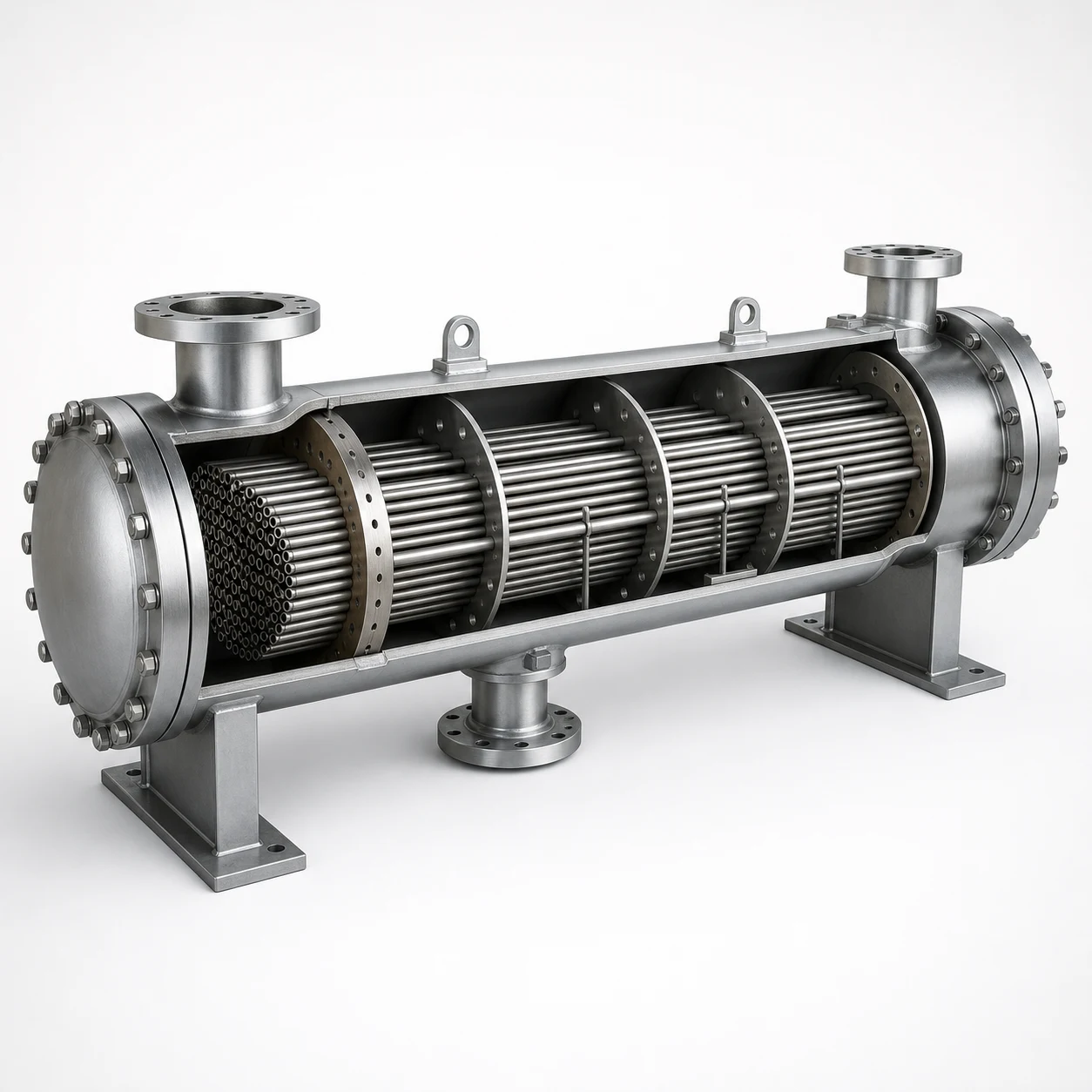
Working Principle and Structure Selection
For heat network service, the primary medium is normally routed on the side that best satisfies pressure, fouling and maintenance requirements. The final tube-side / shell-side allocation is confirmed by thermal design, velocity, pressure drop and inspection access.
Fixed Tube Sheet
Suitable when the wall temperature difference is moderate, or when shell-side pressure and fouling are controlled. It gives a simple and compact body for stable hot-water duties.
Floating Head
Used when shell-to-tube wall temperature difference is larger, or when fouling and corrosion make bundle removal valuable for inspection and cleaning.
U-Tube
Selected for higher temperature or pressure service where the tube-side medium is clean and not easy to scale. The U bend absorbs thermal expansion but changes the cleaning strategy.
Steam-to-Water
When steam is the heat source, condensate drainage, steam inlet control and water circulation sequence become part of the exchanger selection and operating procedure.
Heat Network Operation Logic
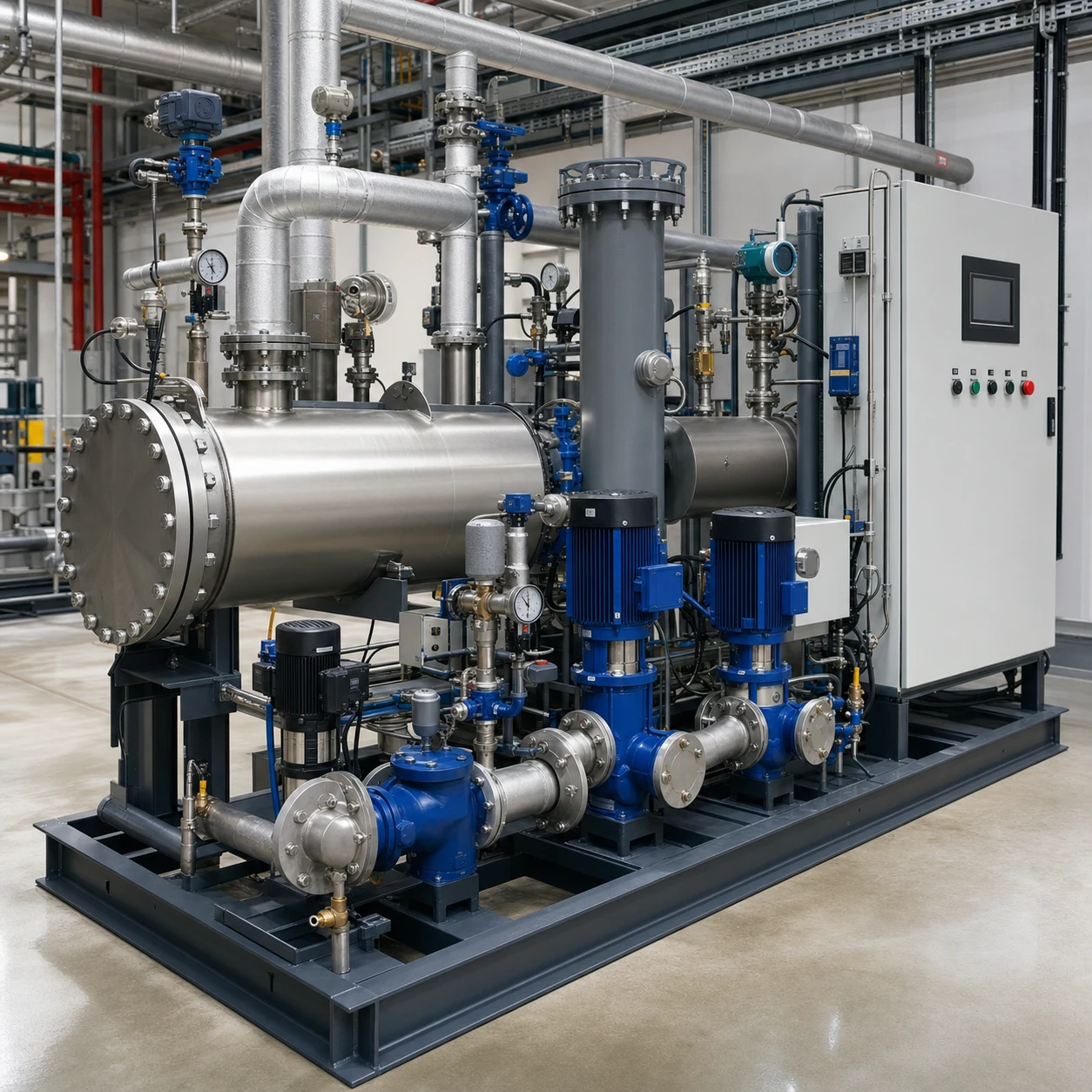
A typical heating station controls secondary supply temperature by adjusting the primary-side heat input. Hengxin's HX-JZ catalog describes electric regulating valves, temperature sensors, pressure transmitters, flow / heat meters, circulating pumps, make-up pressure pumps, dirt separators and control cabinets as station components.
Where District Heating Heat Exchangers Are Used
The equipment is selected for heat transfer between heat-source networks, thermal stations and building-side loops where pressure separation, cleanability and stable winter operation are more important than a very small exchanger footprint.
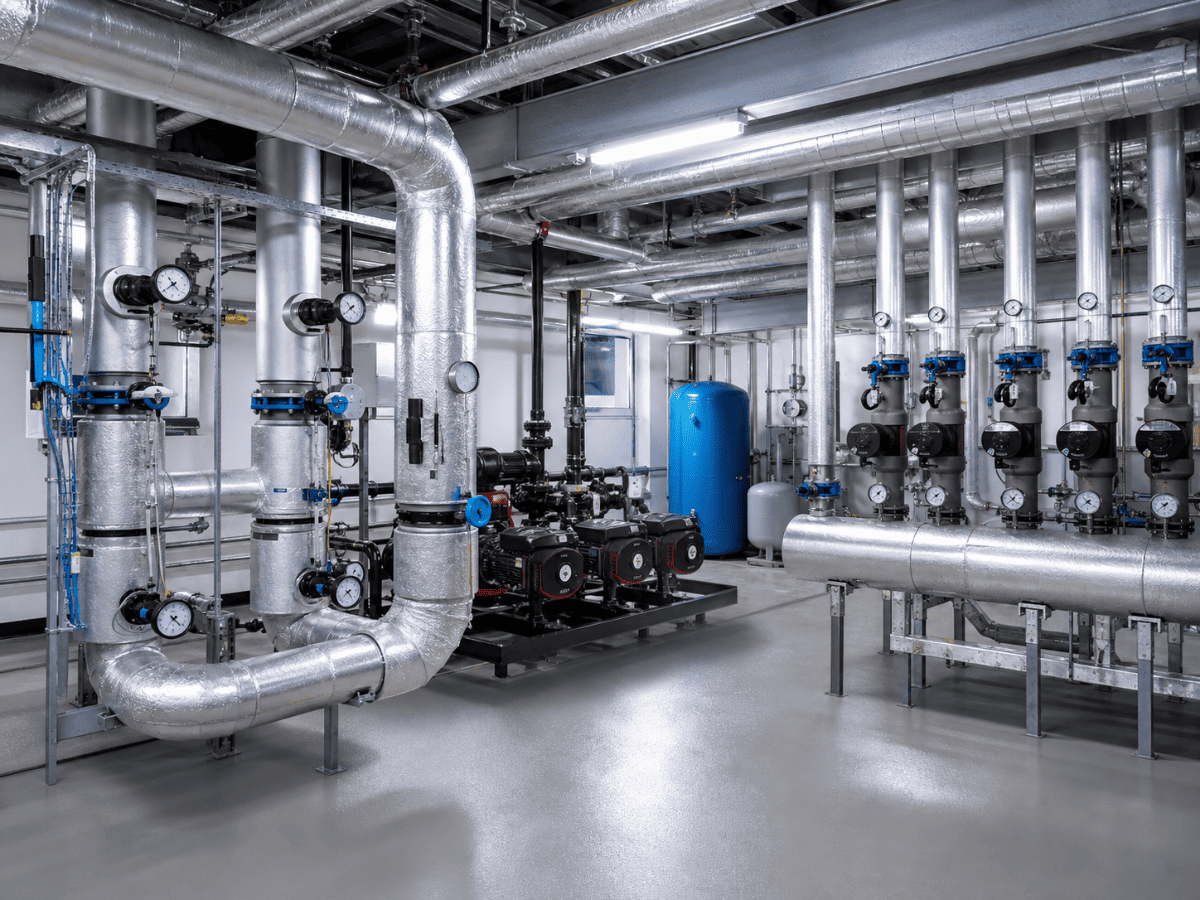
Municipal Heating Substations
Primary heat network water transfers heat to the secondary building loop while maintaining hydraulic separation between the municipal network and end users.
Combined Heat and Power Networks
The HX-JZ catalog positions heat exchange stations for urban cogeneration, community heating and centralized district heating installations.
Steam Source Heating Stations
Steam-to-water heating duties require attention to condensate outlet layout, steam valve sequence, water circulation and outlet temperature control.
Residential Heating
Apartment blocks, residential communities and public buildings with secondary heating water loops.
Campus and Utility Plants
Central boiler rooms, campus energy stations and site-level hot-water distribution loops.
Domestic Hot Water
Bathing and hot-water preparation when operating pressure, water quality and storage strategy are confirmed.
Industrial Heat Users
Process hot water, plant heating and auxiliary thermal loads requiring pressure-vessel heat transfer equipment.
Selection Data Hengxin Needs Before Sizing
A reliable quotation starts from the heating duty and the station boundary conditions. Nominal area alone is not enough because tube pass, shell diameter, tube length, pressure drop and cleaning access all change the final exchanger.
Heat Load
Design heat duty, peak load, turndown range, daily heating profile and whether the exchanger is for base load, peak load or standby duty.
Primary Side
Hot water, steam or thermal oil; inlet and outlet temperatures; operating and design pressure; available pressure drop and flow rate.
Secondary Side
Supply and return temperatures, circulating water flow, static pressure, expansion / make-up system and allowable outlet temperature variation.
Water Quality
Hardness, suspended solids, chloride level, oxygen ingress, scaling risk, corrosion behavior and whether chemical or mechanical cleaning is planned.
Station Layout
Horizontal or vertical installation, nozzle orientation, flange standard, foundation, lifting clearance, bundle-pulling space and drain / vent positions.
Automation Scope
Temperature control valve, outdoor compensation, pump variable-frequency control, heat meter, pressure transmitter, remote monitoring and alarm requirements.
Selection Mechanism, Not Marketing Claims
The exchanger structure is chosen from the duty mechanism. A fixed tube sheet body saves space and material when fouling and thermal expansion are controlled. A floating head adds maintenance access for higher fouling or larger wall temperature difference. A U-tube exchanger handles expansion internally but requires clean tube-side service. Steam heating adds condensate drainage and startup sequence constraints.

Catalog-Based Technical Parameters
The following values are summarized from Hengxin catalog material for shell-and-tube heat exchangers, steam-water exchangers and HX-JZ heat exchange stations. Final dimensions and ratings must be calculated from the project duty and pressure-vessel requirements.
| Item | Catalog Information / Selection Range |
|---|---|
| Applicable equipment family | Shell-and-tube heat network heater, steam-to-water heating exchanger, water-to-water heat exchange station, steam-water heat exchange station and intelligent unattended HX-JZ station. |
| Catalog design and manufacturing basis | GB151 shell-and-tube heat exchanger requirements, GB150 steel pressure vessel requirements and TSG R0004-2009 fixed pressure vessel safety supervision rules are listed in the Hengxin shell-and-tube catalog section. |
| Shell-and-tube design pressure | PN < 10 MPa in the shell-and-tube catalog technical scope. |
| HX-JZ station design boundary | The HX-JZ heat exchange station catalog states maximum design temperature up to 300 deg C and maximum design pressure up to 2.5 MPa. |
| Steam-water catalog duty | The steam-water exchanger section states a steam pressure range of 0.1-0.8 MPa and steam temperature range of 120-180 deg C for the described exchanger configuration. |
| Shell diameter | DN150-2600 catalog shell diameter range. The catalog also notes heat-transfer tube bundle fabrication capability with maximum external diameter up to 3000 mm. |
| Available structures | Floating head, fixed tube sheet, U-tube and packed gland structures; rod-baffle, helical-baffle and double-tube-sheet options can be evaluated for special duties. |
| Tube diameter and length references | Catalog parameter tables include 19 mm and 25 mm tube outside diameter series and tube lengths such as 1.5 m, 2 m, 3 m, 4.5 m, 6 m and 9 m depending on exchanger structure. |
| Main material options | Q235-B, 16MnR, 16Mn forging, 10, 20, 304(L), 316(L), 321 and other materials selected according to medium, pressure, temperature and corrosion conditions. |
| Enhanced heat-transfer tubes | The catalog mentions spiral tubes, transverse corrugated tubes and arc-line tubes for increasing film heat transfer coefficient where fouling, velocity and cleaning method allow their use. |
Model-Code Elements Used in Hengxin Catalog
For shell-and-tube equipment, the catalog model logic combines the mechanical structure, shell diameter, tube-side / shell-side design pressure, nominal heat-transfer area, tube outside diameter, tube length and pass count.
| Catalog Example | Confirmed Example Condition | District Heating Relevance |
|---|---|---|
| Floating head exchanger | DN500, tube and shell design pressure 1.0 MPa, nominal area 54 m², tube OD 25 mm, tube length 6 m, 2 tube passes and single shell pass. | Useful reference when bundle removal is needed because fouling, corrosion or wall temperature difference is significant. |
| Fixed tube sheet exchanger | DN700, tube-side design pressure 2.5 MPa, shell-side design pressure 1.6 MPa, nominal area 200 m², tube OD 25 mm, tube length 9 m, 4 tube passes and single shell pass. | Relevant for compact hot-water duties where shell-side fouling and thermal expansion can be controlled. |
| U-tube exchanger | DN500, tube-side design pressure 1.6 MPa, shell-side design pressure 1.0 MPa, nominal area 75 m², tube OD 19 mm, tube length 6 m, 2 tube passes and single shell pass. | Relevant where thermal expansion is important and the tube-side medium is clean enough for the selected cleaning method. |
| Packed gland exchanger | DN600, tube and shell design pressure 1.0 MPa, nominal area 90 m², tube OD 25 mm, tube length 6 m, 2 tube passes and single shell pass. | Available for project-specific sealing and expansion requirements when the mechanical boundary supports this structure. |
These example conditions are catalog model-code examples, not recommended final sizes. A district heating exchanger must be selected from the project's heat load, temperature program, pressure drop, water quality and installation constraints.
Manufacturing, Inspection and Station Reliability
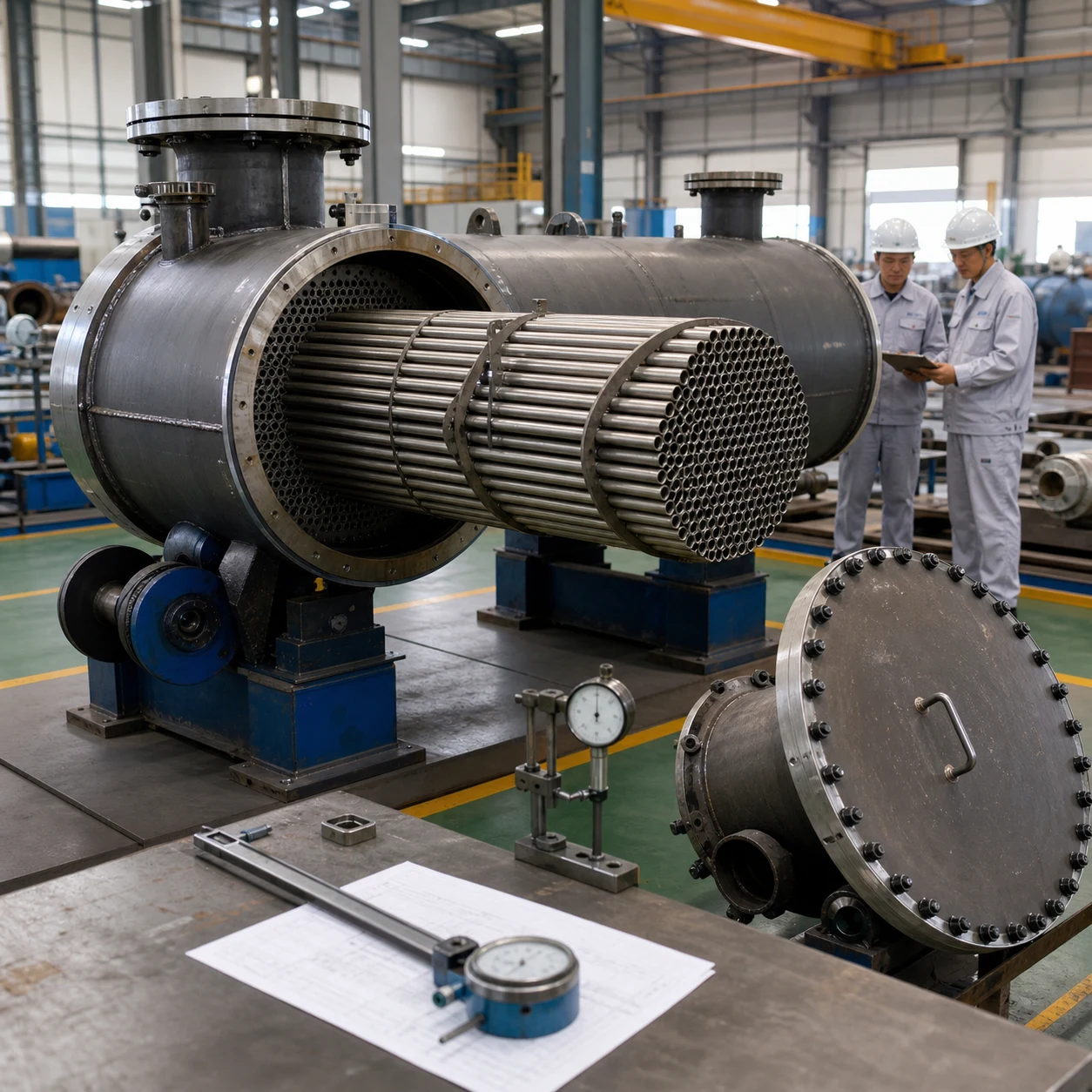
The heat exchanger is a pressure boundary inside the heating station, so fabrication quality matters at tube-to-tube-sheet joints, welds, flange connections, supports and nozzle reinforcement. Hengxin catalog material emphasizes high-efficiency tube development, flexible hydraulic expansion, professional welding equipment and non-destructive testing.
Installation, Operation and Maintenance Notes
The catalog operation notes for heating exchangers are practical: the exchanger must be installed with supported piping, vent and drain points, pressure / temperature indication, dirt removal before startup and a safe sequence for introducing heat.
Before Startup
Install strainers or dirt separators before the exchanger and flush new pipework so construction debris does not enter the tube bundle or control valve.
Startup Sequence
Fill and circulate the cold / secondary water side first, then slowly open the hot-water or steam side. This avoids heating a stagnant water side.
Shutdown Sequence
Close the hot-water or steam side first, then stop the secondary-side circulation pump. In winter shutdown, drain water where freezing risk exists.
Steam Condensate
For steam-water configurations, the catalog notes that condensate should discharge freely and the condensate outlet should not be lifted in a way that causes water accumulation.
FAQ
Common engineering questions about Hengxin district heating heat exchangers, heat network heaters and HX-JZ heat exchange station integration.
Is this page about a plate heat exchanger or a shell-and-tube heat exchanger?
This page is positioned around district heating heat exchangers, especially shell-and-tube heat network heaters and station heat exchangers. Plate exchangers can be used in some heating systems, but the technical parameters here are based mainly on Hengxin shell-and-tube, steam-water and HX-JZ station catalog sections.
What pressure and diameter range does Hengxin list for shell-and-tube equipment?
The shell-and-tube catalog scope lists design pressure PN < 10 MPa and shell diameter DN150-2600. Final design pressure and shell size depend on actual heat load, pressure drop, material and pressure-vessel review.
When should a floating head structure be considered for district heating?
It should be considered when shell-to-tube wall temperature difference is large, or when fouling and corrosion make removable-bundle inspection and cleaning important. It is more complex than fixed tube sheet construction but improves maintenance access.
What information is required for quotation?
Send heat duty, primary and secondary media, inlet and outlet temperatures, flow rates, operating and design pressures, allowable pressure drop, water quality, installation orientation, nozzle standard, material requirements and automation scope.
Can Hengxin supply the exchanger as part of a complete heat exchange station?
Yes. The HX-JZ catalog describes water-water, steam-water and intelligent unattended heat exchange station types, including exchanger, circulating pump, make-up pressure pump, dirt separator, control cabinet, instruments, pipes and valves.
What controls are available for heating station operation?
The catalog describes secondary supply temperature control through a primary-side electric regulating valve, outdoor temperature compensation, variable-frequency circulating pump control, make-up pressure control, low-level protection, overpressure relief and optional remote communication.
What materials can be selected?
Hengxin's shell-and-tube catalog lists Q235-B, 16MnR, 16Mn forging, 10, 20, 304(L), 316(L), 321 and related options. The final material is selected from water quality, corrosion risk, pressure, temperature and project standards.