
What Is a Shell and Tube Heat Exchanger?
A shell and tube heat exchanger separates two media through tube walls. One medium flows inside the tube bundle, while the other medium flows through the shell side across the tubes. Hengxin builds this equipment as pressure-vessel heat transfer equipment for duties where mechanical strength, cleanable structure and custom material selection matter more than a compact plate footprint.
Built Around Tube Bundle, Tube Sheet and Shell-Side Flow
The mechanical design begins with the shell diameter, tube diameter, tube length, tube pass arrangement, shell-side flow path, tube sheet and channel head. The final exchanger is selected from actual media, inlet and outlet temperature, pressure, pressure drop, fouling tendency, corrosion allowance and maintenance access.
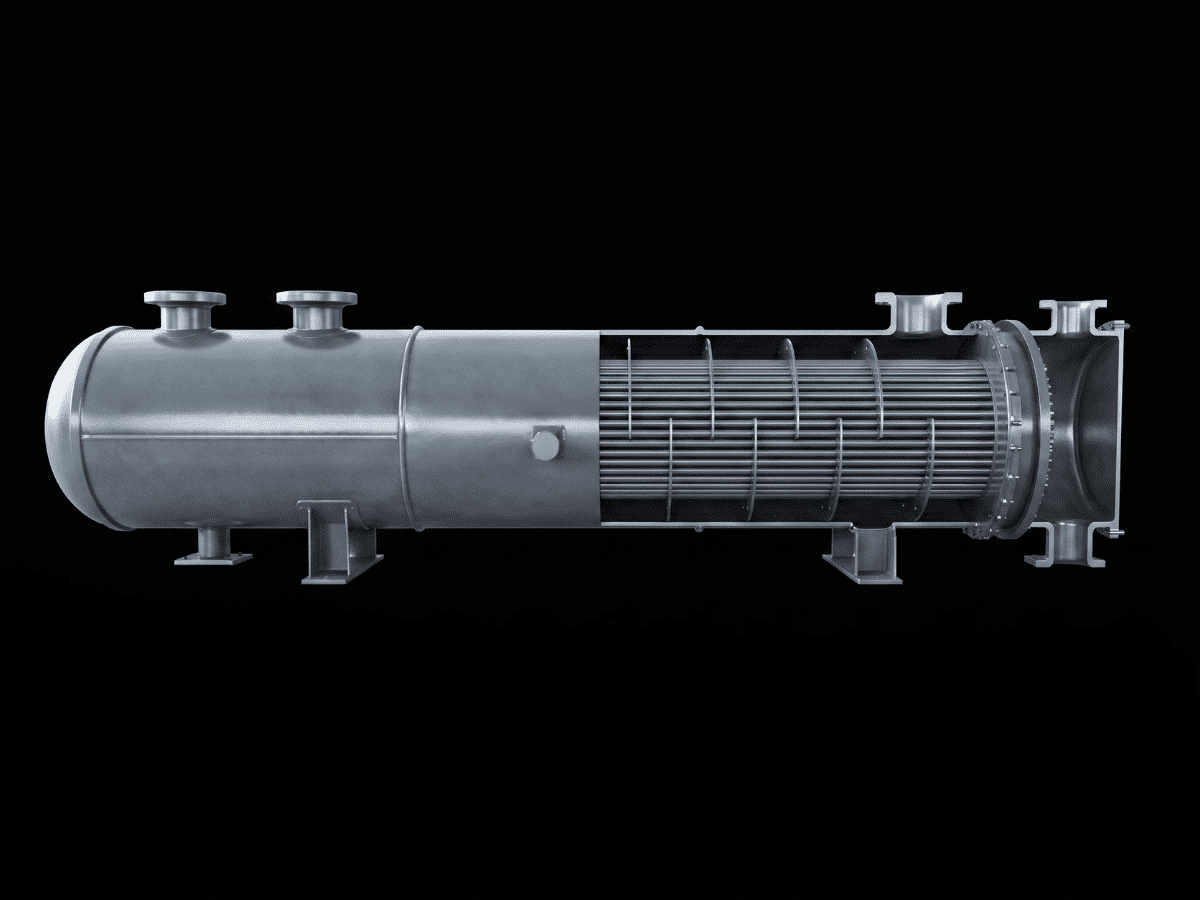
Structure Options for Different Operating Conditions
The Hengxin catalog lists floating head, fixed tube sheet, U-tube and packed gland structures. These are not interchangeable names; each structure solves a different combination of thermal expansion, fouling, pressure and maintenance access.
Floating Head Exchanger
Recommended when the temperature difference between shell and tube walls is large, or when corrosion and fouling require bundle removal. The structure is more complex and uses more material, but it improves maintenance access.
Fixed Tube Sheet Exchanger
Suitable when the temperature difference is moderate, or when shell-side pressure is not high and shell-side fouling can be controlled or chemically cleaned. It is simple, compact and material-efficient.
U-Tube Exchanger
Used for high-temperature and high-pressure service where tube-side media are clean and not easy to scale. The longer flow path supports heat transfer performance and pressure-bearing capability.
Packed Gland Exchanger
Available as a traditional shell-and-tube form for project-specific expansion and sealing requirements. Hengxin reviews the sealing form according to pressure, media and site maintenance conditions.
Enhanced Tube and Baffle Options
In addition to traditional structures, Hengxin can manufacture rod-baffle, helical-baffle and double-tube-sheet exchangers. The catalog also notes high-efficiency heat transfer tubes such as spiral tubes, transversely corrugated tubes and arc-line tubes for improving film heat transfer coefficients on the tube side and shell side.
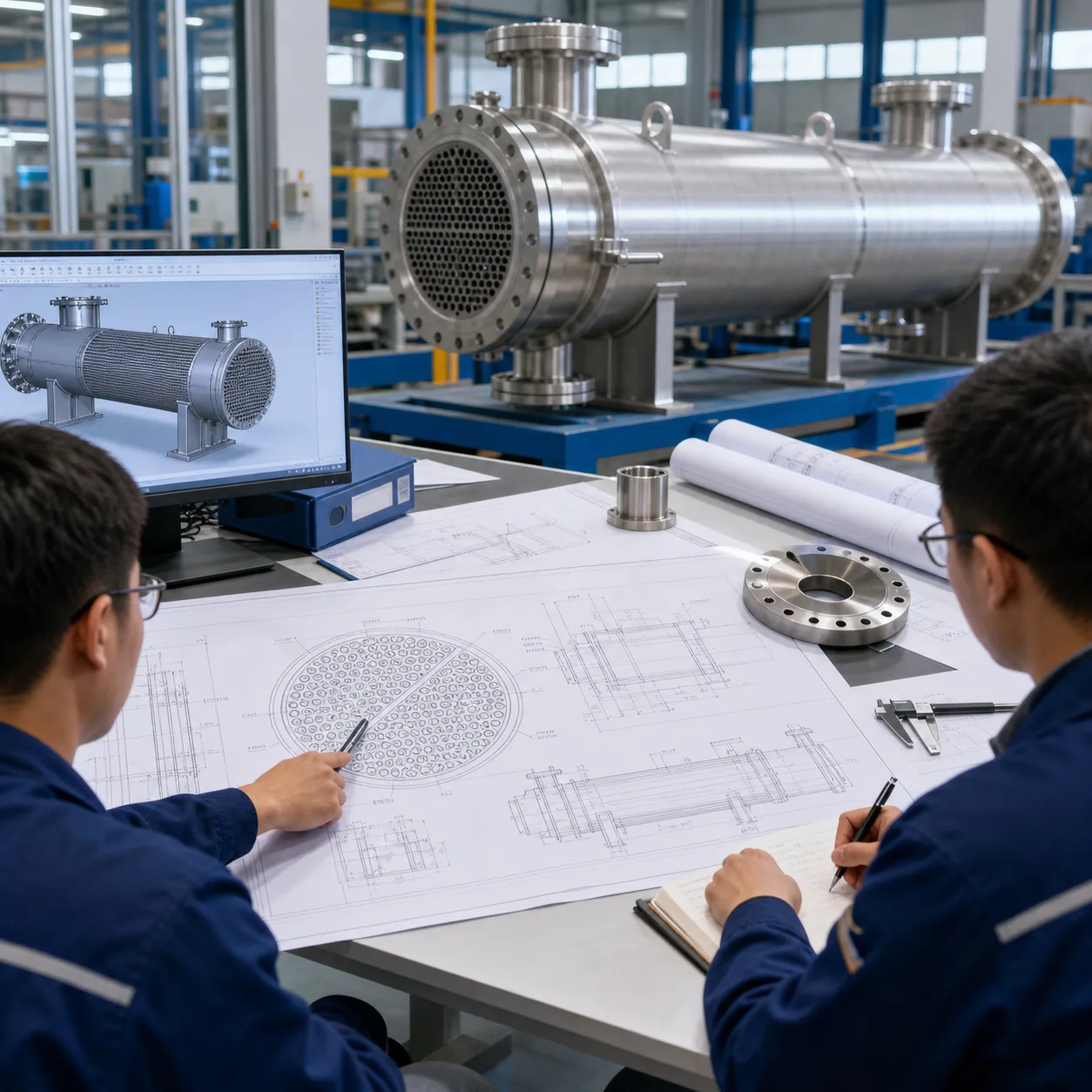
Process Applications of Shell and Tube Heat Exchangers
Shell-and-tube exchangers are selected when the duty needs robust pressure containment, large heat transfer area, project-specific materials or a structure that can tolerate heavier industrial media than gasketed plate units.
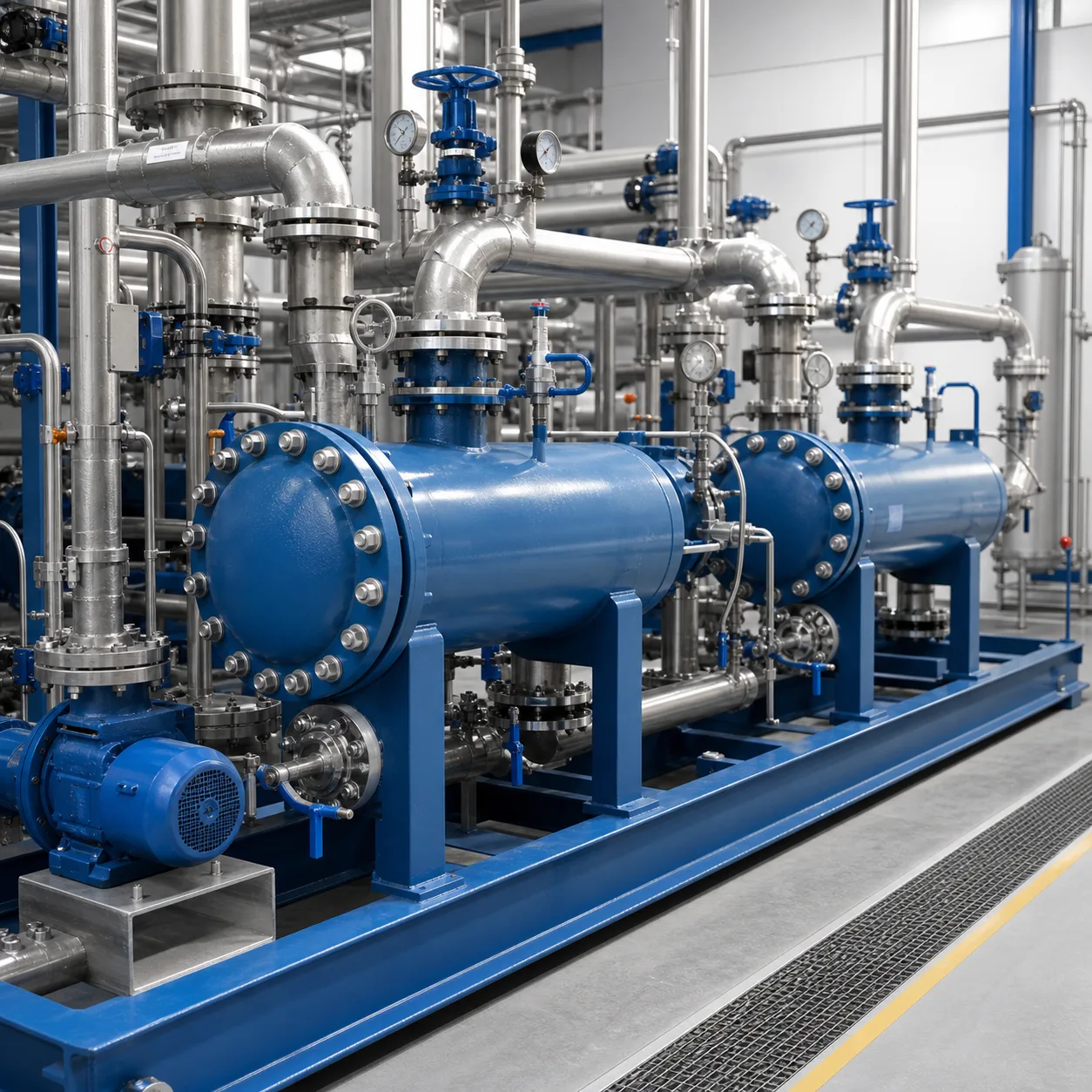
Steam, Water and District Heating
Used for steam-water heating, hot water systems, heating network equipment and industrial thermal stations where pressure and temperature conditions require pressure-vessel construction.
Chemical and Petrochemical Duty
Applied to process heating, cooling, condensation and heat recovery with customized materials, tube arrangement and cleanability according to corrosion and fouling behavior.
Oil, Gas and Heavy Industrial Media
Suitable for oil cooling or heating, high pressure differential service, larger flow rates and conditions where gasket compatibility or plate-channel blockage becomes a concern.
Heating
For steam, hot water, thermal oil or process fluid heating duties.
Cooling
For cooling water loops, oil cooling and process liquid temperature control.
Condensing
For vapor condensation and recovery when robust tube bundles are required.
Heat Recovery
For recovering sensible or latent heat from industrial process streams.
How to Select a Shell and Tube Heat Exchanger
Shell-and-tube selection should not start from nominal area alone. Hengxin engineers first define the duty, media properties and mechanical boundary conditions, then confirm structure, tube material, pass arrangement and maintenance method.
Heat Duty and Flow Rate
Required heat load, hot-side and cold-side flow rates, physical properties and whether the duty is heating, cooling, condensing or recovery.
Temperature Program
Inlet and outlet temperatures on both sides, phase change conditions and any risk of thermal shock or large wall temperature difference.
Pressure and Pressure Drop
Tube-side and shell-side operating pressure, design pressure, allowable pressure drop and pressure differential between media.
Medium and Corrosion
Fluid composition, chloride or corrosive components, viscosity, solids content, scaling risk and required material grade.
Cleaning and Maintenance
Mechanical cleaning, chemical cleaning, removable bundle needs, inspection access, expected fouling and shutdown interval.
Site and Connection Data
Horizontal or vertical layout, nozzle orientation, flange standard, installation space, lifting clearance and support requirements.
Catalog-Based Technical Parameters
The following data is summarized from Hengxin product catalog material for shell-and-tube heat exchangers. Final values are confirmed by project design, selected material and applicable pressure-vessel requirements.
| Item | Catalog Information / Selection Range |
|---|---|
| Design and manufacturing basis | GB151 shell-and-tube heat exchanger requirements, GB150 steel pressure vessel requirements, and TSG R0004-2009 fixed pressure vessel safety supervision rules as listed in Hengxin catalog. |
| Available structures | Floating head, fixed tube sheet, U-tube, packed gland; rod baffle, helical baffle and double tube sheet options available for project-specific duties. |
| Design pressure | PN < 10 MPa in the catalog technical scope. |
| Design temperature | Within the allowable service temperature of the selected metal material. |
| Shell diameter | DN150-2600 catalog shell diameter range; the catalog also notes large heat-transfer tube bundle fabrication capability with maximum external diameter up to 3000 mm. |
| Main material options | Q235-B, 16MnR, 16Mn forging, 10, 20, 304(L), 316(L), 321 and other material options according to medium, pressure, temperature and corrosion requirements. |
| Heat transfer tube options | Straight tube bundle with standard tube diameters used in model tables; enhanced tubes such as spiral tube, transverse corrugated tube and arc-line tube may be evaluated where suitable. |
How the Model Code Is Built
Hengxin catalog model logic combines exchanger structure, nominal diameter, tube-side / shell-side design pressure, nominal heat-transfer area, tube outside diameter, tube length and tube-pass / shell-pass count.
| Catalog Example | Confirmed Example Condition | Why It Matters |
|---|---|---|
| Floating head exchanger | DN500, tube and shell design pressure 1.0 MPa, nominal area 54 m², tube OD 25 mm, tube length 6 m, 2 tube passes, single shell pass. | Shows a removable-bundle structure used when expansion, corrosion or fouling makes maintenance access important. |
| Fixed tube sheet exchanger | DN700, tube-side design pressure 2.5 MPa, shell-side design pressure 1.6 MPa, nominal area 200 m², tube OD 25 mm, tube length 9 m, 4 tube passes, single shell pass. | Shows a compact structure for duties where shell-side fouling and thermal expansion can be controlled. |
| U-tube exchanger | DN500, tube-side design pressure 1.6 MPa, shell-side design pressure 1.0 MPa, nominal area 75 m², tube OD 19 mm, tube length 6 m, 2 tube passes, single shell pass. | Shows a structure selected for high-temperature and high-pressure service with clean tube-side media. |
| Packed gland exchanger | DN600, tube and shell design pressure 1.0 MPa, nominal area 90 m², tube OD 25 mm, tube length 6 m, 2 tube passes, single shell pass. | Shows another traditional structure available for custom mechanical and sealing requirements. |
Do not use the example models as final sizing. They are catalog model-code examples. Final heat-transfer area, pressure rating and material selection must be calculated from actual working conditions.
Manufacturing and Quality Control
Hengxin catalog materials emphasize high-efficiency heat-transfer tube development, flexible hydraulic expansion, professional welding equipment and non-destructive testing. These are important because a shell-and-tube exchanger fails most often at mechanical joints, welds, tube-to-tube-sheet connections or from uncontrolled vibration and fouling.
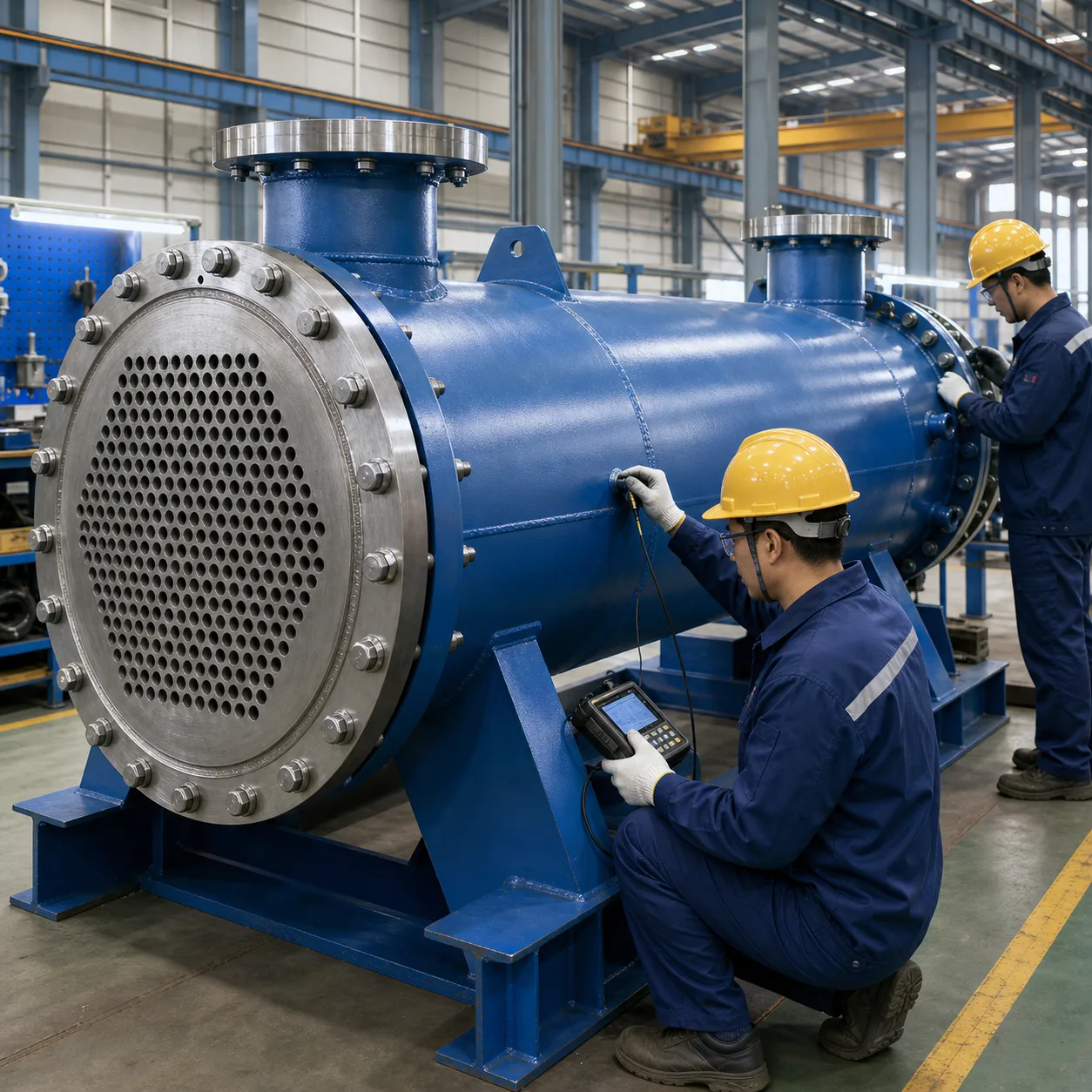
Installation, Operation and Maintenance Considerations
Operation planning should match the selected structure. A floating head exchanger is easier to open for bundle inspection; a fixed tube sheet unit depends more on controlled fouling and cleaning method; a U-tube unit suits clean tube-side fluids but needs attention to bend-side cleaning limits.
Thermal Expansion
Large shell-to-tube wall temperature differences should be reviewed early because they influence whether floating head, U-tube or expansion-joint solutions are required.
Fouling and Cleaning
Scaling, solids or sticky media affect tube diameter, velocity, baffle spacing, removable-bundle need and whether mechanical or chemical cleaning is realistic.
Nozzle and Support Layout
Nozzle orientation, drain/vent positions, supports, lifting space and maintenance clearance must match the site layout before fabrication.
Inspection Documents
Pressure testing, weld inspection, material confirmation and nameplate data should be aligned with the pressure-vessel requirements of the project.
FAQ
Common questions about Hengxin shell-and-tube heat exchangers, including structure selection, technical parameters, materials and project data required for quotation.
What structures can Hengxin manufacture?
Hengxin catalog materials list floating head, fixed tube sheet, U-tube and packed gland shell-and-tube exchangers. Rod baffle, helical baffle, double tube sheet and enhanced heat-transfer tube options can also be evaluated for special duties.
What is the catalog pressure and diameter range?
The Hengxin catalog states design pressure PN < 10 MPa and shell diameter DN150-2600. Actual design pressure, temperature and diameter depend on project conditions, material and pressure-vessel review.
When should a floating head exchanger be selected?
A floating head exchanger is suitable when the temperature difference between tube and shell walls is large, or when corrosion and fouling make removable bundle maintenance important. It is mechanically more complex and uses more material.
When is a fixed tube sheet exchanger appropriate?
It is suitable when the wall temperature difference is not large, or when the temperature difference is larger but shell-side pressure is low and shell-side fouling is not serious or can be chemically cleaned. It is simple, compact and material-efficient.
What project data is needed for selection?
Hengxin usually needs medium names and composition, flow rates, inlet and outlet temperatures, operating and design pressure, allowable pressure drop, fouling and cleaning requirements, material preference, nozzle standard and installation layout.
Can Hengxin support non-standard materials?
The catalog lists Q235-B, 16MnR, 16Mn forging, 10, 20, 304(L), 316(L), 321 and related options. Final material selection is confirmed from corrosion, pressure, temperature and fluid compatibility.