
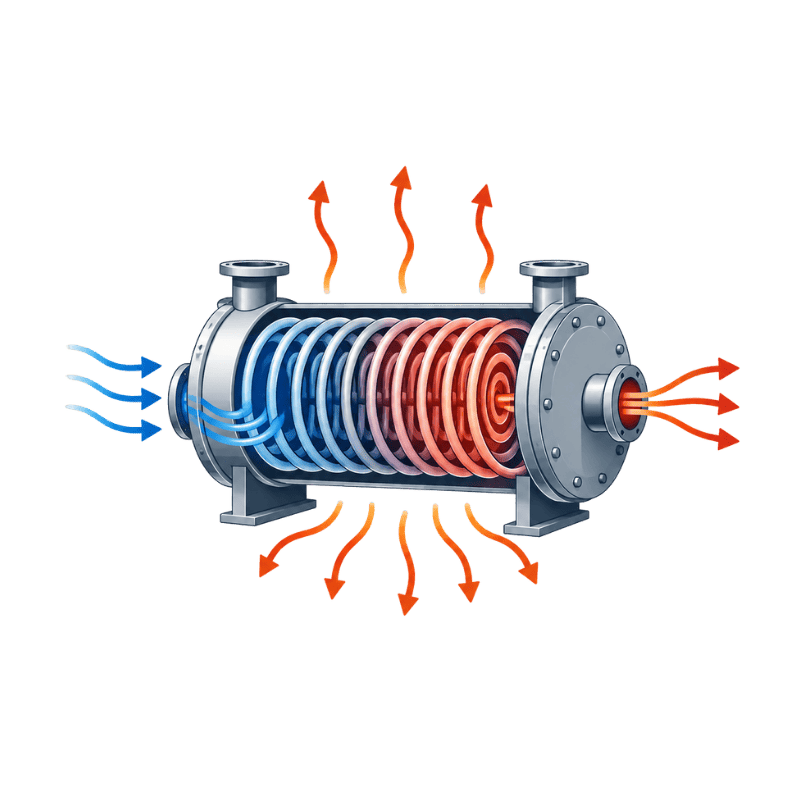
Enhanced Heat Transfer
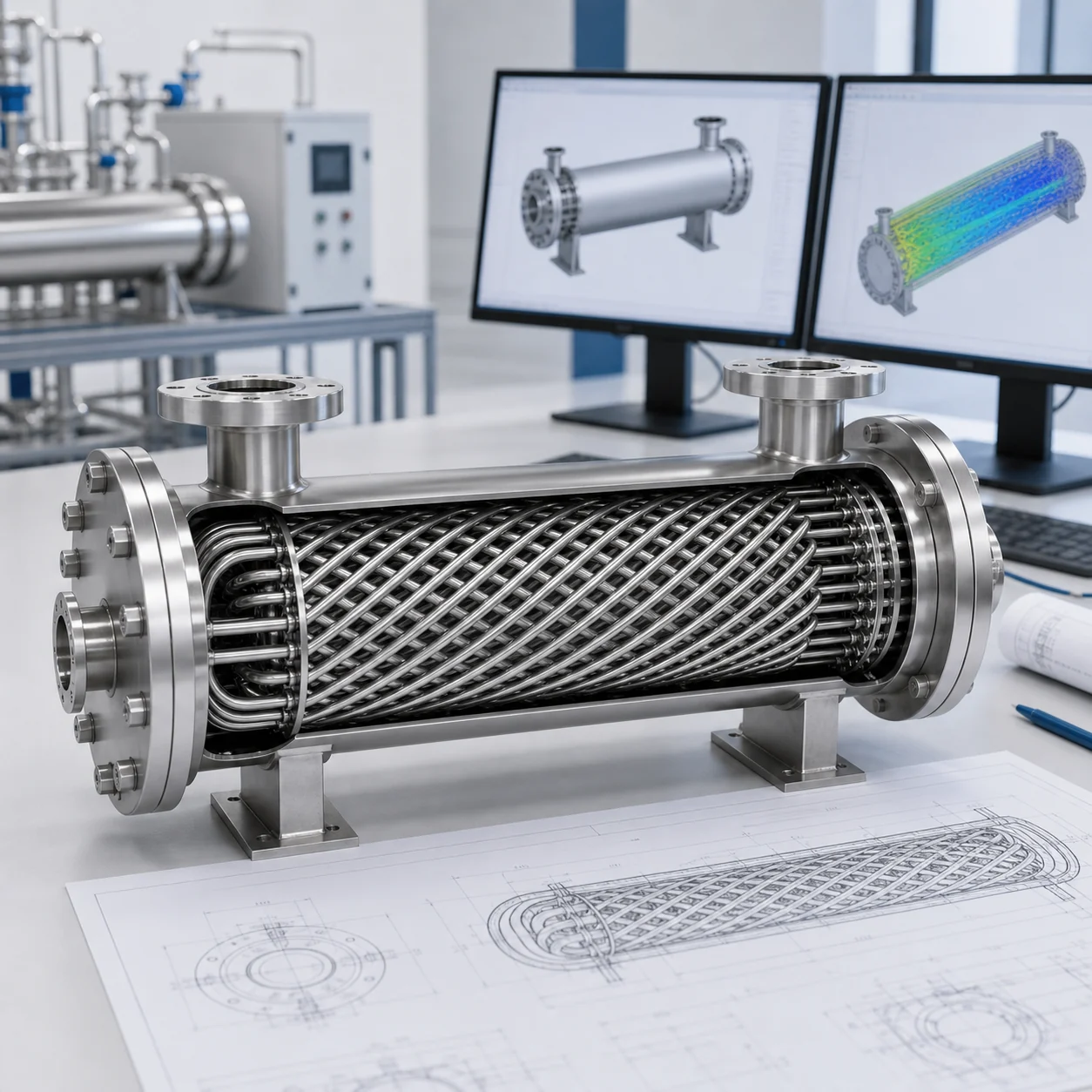
Spiral flow paths help create strong turbulence and improve heat exchange between hot and cold media.
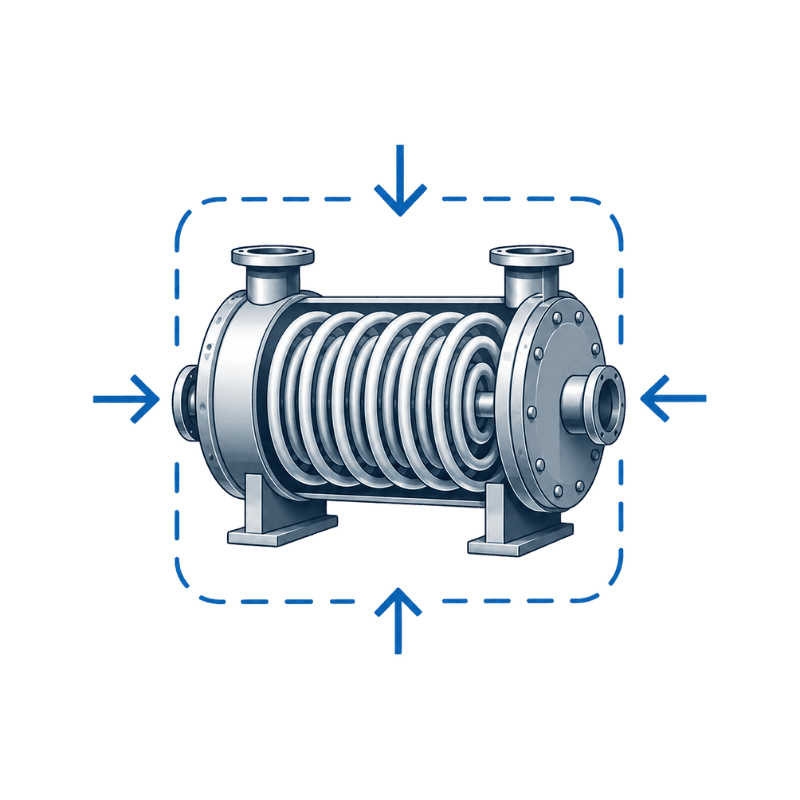
Compact Footprint
Under comparable operating conditions, equipment volume can be reduced to about 1/5 of a traditional exchanger, depending on the duty.

Custom Process Design
Each unit can be selected according to heat duty, media, flow rate, temperature, pressure, material and installation requirements.
Reliable Stainless-Steel Structure
Stainless-steel tubes, shell and connection options are available to support stable operation in chemical, pharmaceutical, food and industrial processes.
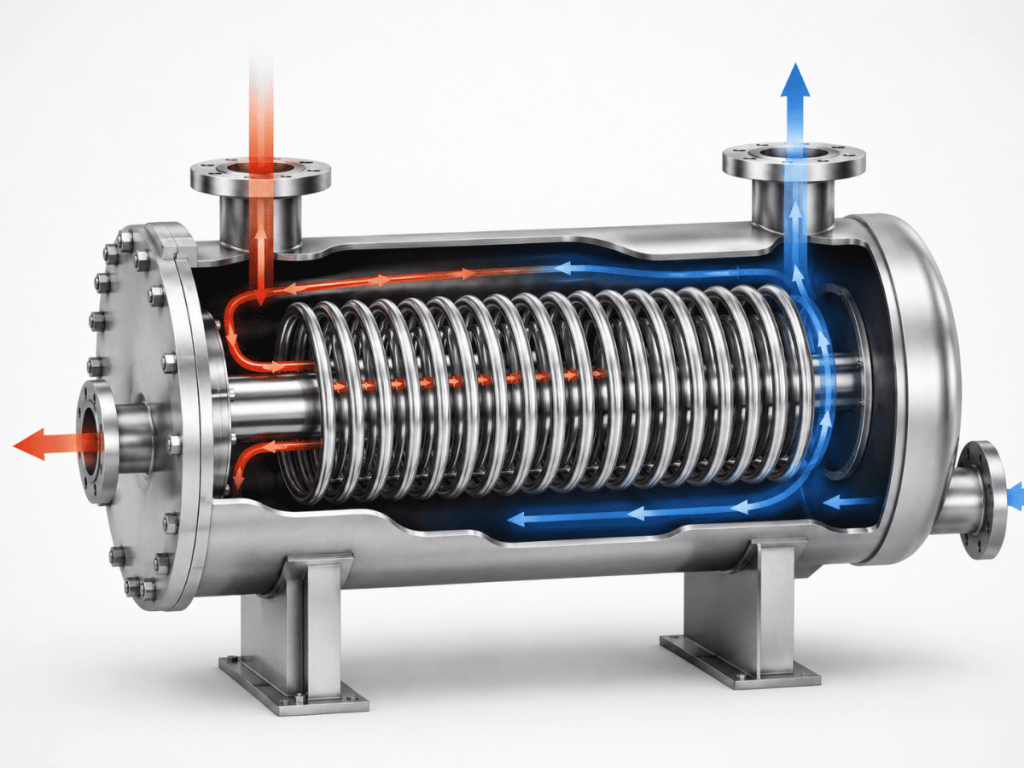
Spiral Wound Tube vs Spiral Plate Heat Exchanger
Search results for "spiral heat exchanger" may include welded spiral plate exchangers, but this Hengxin product page refers to a spiral wound tube heat exchanger, also called a spiral threaded tube heat exchanger in some product materials. The two names should not be treated as interchangeable during selection.
| Selection Point | Spiral Wound Tube Heat Exchanger | Spiral Plate Heat Exchanger |
|---|---|---|
| Heat transfer structure | Multiple heat transfer tubes are wound into a compact helical bundle inside a shell. | Heat transfer is usually arranged through welded spiral plate channels. |
| Hengxin page scope | This page covers Hengxin spiral wound tube / spiral threaded tube heat exchangers. | This page is not a generic welded spiral plate exchanger specification page. |
| Selection focus | Tube OD, winding layers, tube count, heat transfer area, material, installation direction and process duty. | Plate channel form, plate channel spacing, fouling behavior and plate-side flow path need separate confirmation. |
| Typical project fit | Condensation, reflux, solvent recovery, vacuum recovery, CIP heating, sterilization, heating, cooling and heat recovery. | Often evaluated separately when the project specifically requires a spiral plate channel design. |
Designed for Efficient and Stable Heat Exchange
Hengxin spiral wound tube heat exchangers are not selected only by nominal area. The design considers flow-induced vibration, acoustic resonance, flow velocity, stress distribution and asymmetric shell-side / tube-side volume requirements.
Catalog-Backed Performance References
Extended Tube Path
The wound tube path can be about 3-5 times the shell length, increasing heat transfer path length inside a compact shell.
Higher Heat Transfer Capacity
Under suitable operating conditions, the product sample states heat transfer capacity can be about 3-7 times that of conventional exchangers, with heat transfer coefficient up to 14000 W/m²·°C under specific conditions.
Compact and Lightweight
For comparable duties, the sample describes volume around 1/5 of a traditional exchanger and mass around 1/10, depending on duty and configuration.
Velocity and Fouling Control
Design velocity can be up to 5.5 m/s. Smooth stainless-steel tubes and suitable velocity help reduce deposition and scaling tendency.
Process Applications of Spiral Wound Tube Heat Exchangers
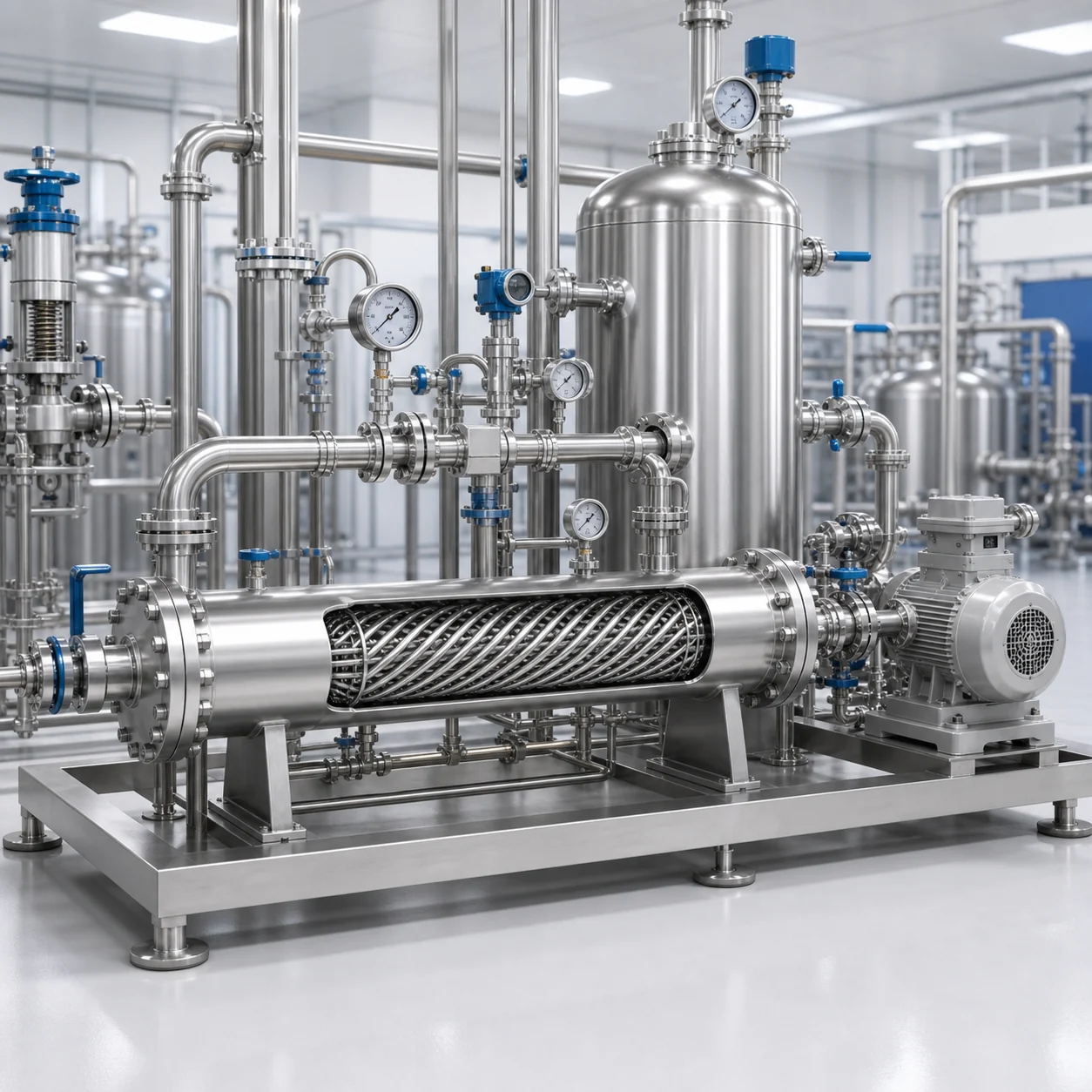
This product is selected by process duty rather than by industry alone. It is especially suitable where longer heat transfer paths, compact equipment size and reliable stainless-steel construction are required.
Condensation, Reflux and Recovery
Used for atmospheric reflux, vacuum condensation recovery, rectification tower-top condensation, solvent recovery and tail gas heat recovery.
Concentration and Extraction
Supports vacuum concentration, alcohol extraction, water extraction and recovery of heat-sensitive or high-boiling process materials.
CIP Heating and Sterilization
Suitable for pharmaceutical, food and beverage online cleaning, instant heating and high-temperature sterilization processes.
Atmospheric Reflux
For pharmaceutical and chemical reaction reflux and solvent condensation.
Vacuum Recovery
For concentration, extraction and solvent vapor recovery under reduced pressure.
Tail Gas Recovery
For vacuum pump exhaust, secondary flash steam and recoverable vapor streams.
Heating and Cooling
For process water, air, oil, material liquid and complex mixed process media.
Typical Process Configurations
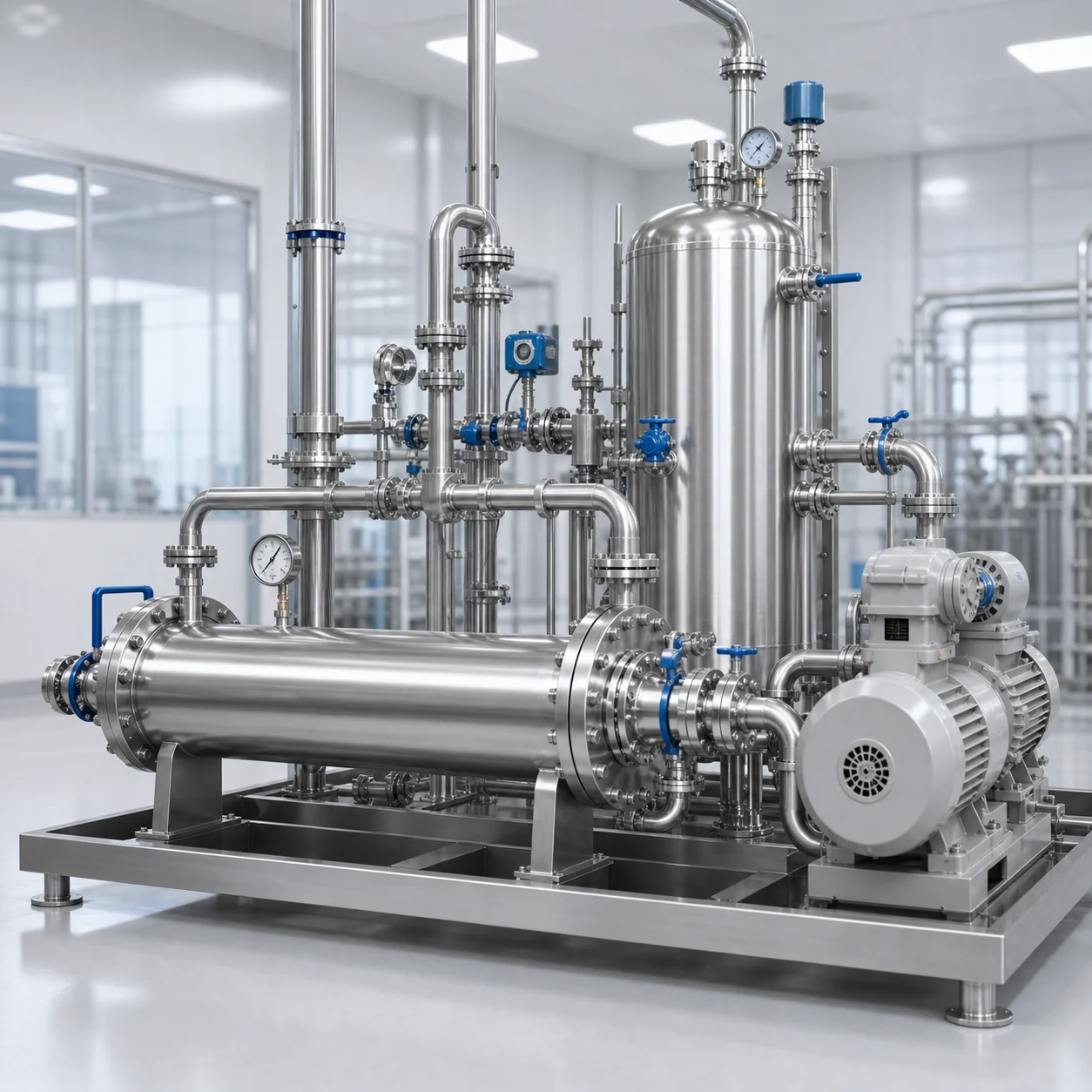
Spiral wound tube heat exchangers are often installed as part of condensation, recovery and vacuum systems. Hengxin can support model selection based on the process flow, media and operating conditions.
Atmospheric Reflux System
For reaction reflux and solvent condensation under atmospheric conditions.
Vacuum Condensation Recovery
For vacuum concentration and solvent recovery where vapor flow velocity is high.
Recovery Before Vacuum Pump
For recovering materials and heat before gas enters the vacuum pump system.
Recovery After Vacuum Pump
For post-pump exhaust recovery, secondary flash steam and emission reduction.
How to Select a Spiral Wound Tube Heat Exchanger
A spiral wound tube heat exchanger must be selected according to actual operating conditions. Complete process data helps Hengxin recommend the correct model, material and installation configuration.
Project Purpose and Heat Duty
Process design, quotation, engineering bid or replacement requirement, plus total heat load in kW when available.
Hot and Cold Side Data
Medium name and state, flow rate, inlet/outlet temperature, operating pressure and allowable pressure drop.
Mixture and Material Needs
Composition or mass ratio for mixed media, plus corrosion, temperature, pressure and sanitation requirements.
Installation Direction
Vertical or horizontal installation, site limits, maintenance access and equipment layout requirements.
Connection Requirements
Hot-side and cold-side nozzle size, flange standard, threaded or quick connection options.
Cleaning Requirements
Cleaning connection needs and expected fouling, scaling or process residue conditions.
Technical Parameters and Materials
| Item | Typical Options |
|---|---|
| Product type | Spiral wound tube heat exchanger / spiral threaded tube heat exchanger |
| Application | Condensing, reflux, solvent recovery, concentration, heating, cooling and heat recovery |
| Design temperature | Up to 203°C |
| Design pressure / test pressure | Up to 1.6 MPa design pressure; 2.0 MPa test pressure |
| Heat transfer tube OD | Ø8 / Ø10 / Ø12 mm |
| Tube material | ANSI 316L; 2205 optional depending on medium |
| Shell material | SUS304 stainless steel tube |
| Tube plate | SUS304; ANSI 316L / 2205 optional |
| Connections | Flange, threaded or quick connection options; optional flange cleaning connection |
How to Read the Model Code
Example: JG6.48.08S-2.0
| Tube Series | Example Model Range | Approx. Area Range | Typical Shell Diameter Range | Typical Connection Range |
|---|---|---|---|---|
| Ø8 series | JG3.18.08-0.8 to JG17.270.08-37 | 0.8-37 m² | 102x3 to 377x6 | DN50-PN1.6 to DN150/DN200-PN1.6 |
| Ø10 series | JG4.32.10-2.5 to JG16.294.10-50 | 2.5-50 m² | 168x3 to 457x6 | DN80-PN1.6 to DN150/DN250-PN1.6 |
| Ø12 series | JG3.22.12-2.0 to JG13.200.12-50 | 2.0-50 m² | 168x3 to 457x6 | DN80-PN1.6 to DN150/DN250-PN1.6 |
Installation, Operation and Maintenance Support

Installation
Read technical documents before installation. Do not weld, drill or modify the exchanger on site. Install a Y-type strainer at the circulating water inlet.

Operation
Avoid sudden cold shock, sudden heat shock, over-pressure and water hammer. Monitor temperature, pressure and flow during operation.

Cleaning
Cleaning is recommended when operating parameters deviate from design, pressure drop changes significantly, or heating speed becomes insufficient.

Storage
If the exchanger will not be used for a long period, drain it, keep it dry and seal the ports to reduce freezing and corrosion risk.

Cleaning Reference
The product sample mentions circulation soaking with 5-10% dilute nitric acid as a common method, subject to material compatibility.

Inspection Trigger
The sample uses a pressure-drop change of 0.05 MPa as a common reference point for inspection or cleaning.
Manufacturer Support From Design to Delivery
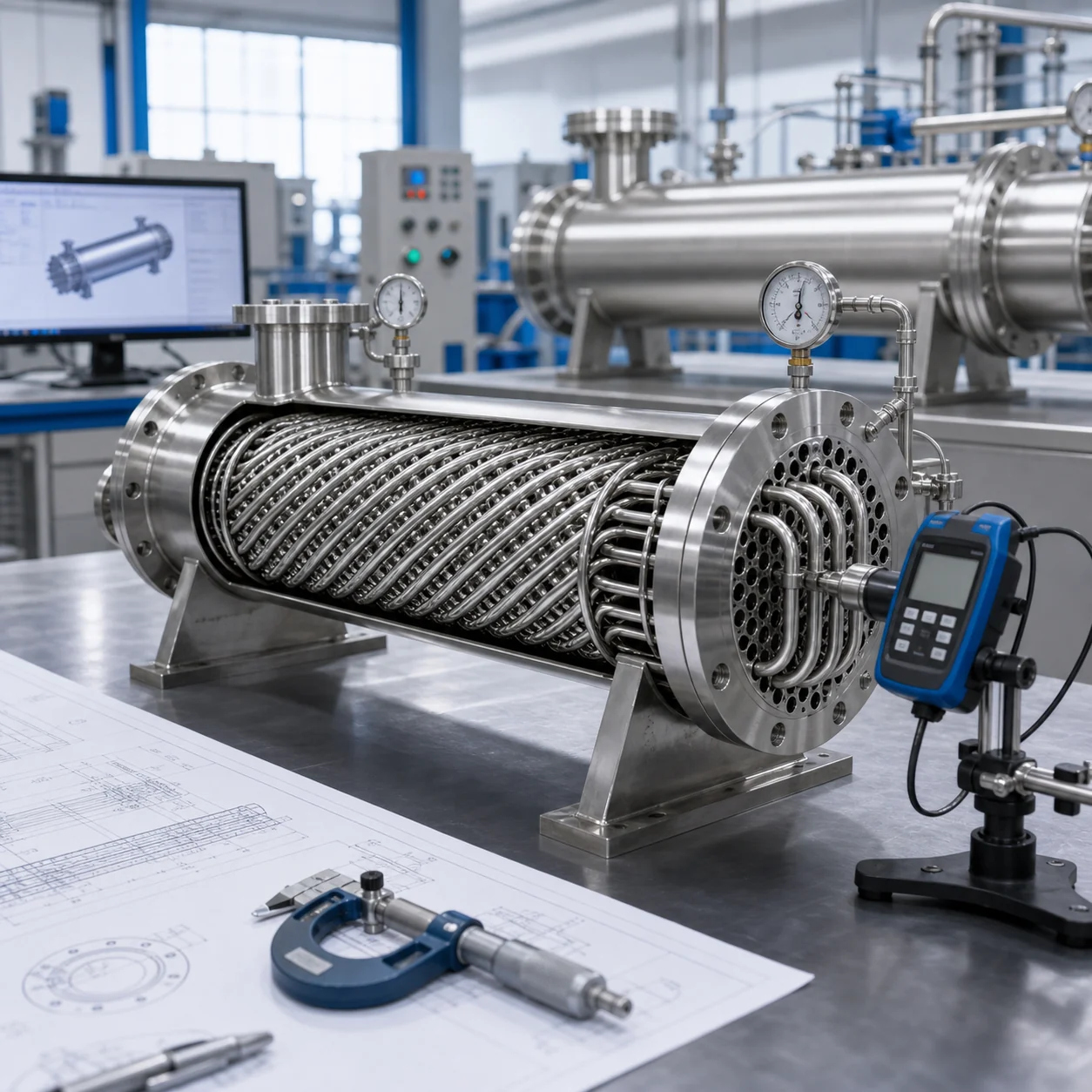
Hengxin focuses on the development, design and manufacturing of heat exchangers and pipeline fluid equipment. Engineering support covers working-condition review, thermal design, material selection, spiral tube bundle fabrication, assembly, pressure testing and delivery documentation.
FAQ
Below are common questions about Hengxin spiral wound tube heat exchangers, including selection data, materials, tube sizes, process applications and custom design support.
What is a spiral wound tube heat exchanger?
It is a compact shell-and-tube heat exchanger using multiple helical heat transfer tubes inside a shell. The structure extends the heat transfer path and strengthens turbulence for condensation, heating, cooling and heat recovery.
What information is required for selection?
Hengxin usually needs heat duty, hot and cold media, flow rate, inlet and outlet temperatures, operating pressure, mixture composition if applicable, installation direction, connection size and material requirements.
What materials are available?
Typical configurations include SUS304 shell and connections, ANSI 316L heat transfer tubes, optional 2205 tubes, and SUS304 / ANSI 316L / 2205 tube plate options depending on medium and pressure.
What tube sizes are available?
Standard heat transfer tube outer diameters include Ø8, Ø10 and Ø12 mm series. The suitable tube size depends on media, heat duty, pressure drop and installation requirements.
Is it suitable for solvent recovery and condensation?
Yes. It is suitable for atmospheric reflux, vacuum condensation recovery, rectification condensation, solvent recovery and tail gas heat recovery in chemical, pharmaceutical and environmental processes.
Can Hengxin design non-standard models?
Yes. Standard model tables cover multiple Ø8, Ø10 and Ø12 series, and non-standard products can be designed according to customer requirements and actual working conditions.