
What Is a Storage-Type Heat Exchanger?
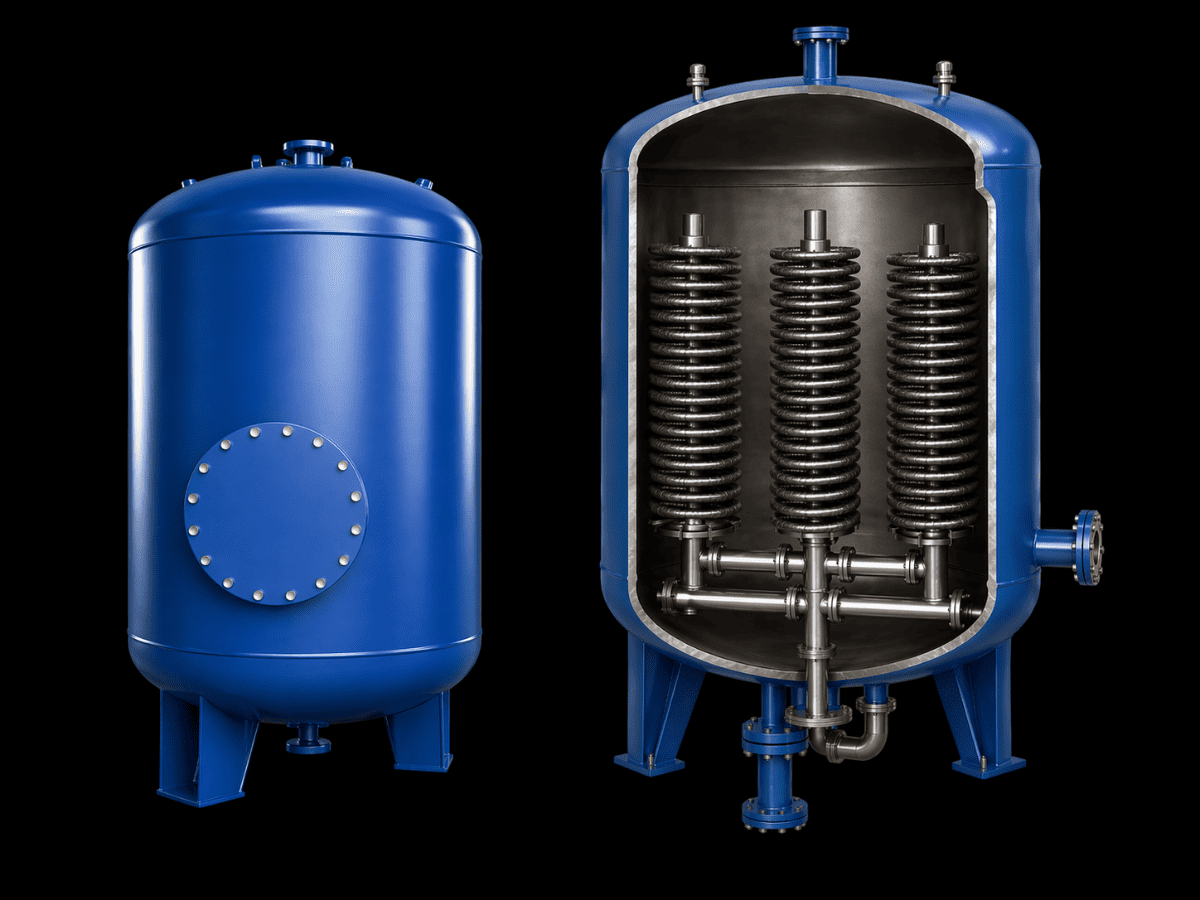
A storage-type heat exchanger combines hot-water storage volume and heat transfer in one pressure-vessel body. Instead of sizing only for instantaneous flow, the vessel stores a controlled volume of hot water and uses internal heat-transfer coils to recover temperature after draw-off.
Volumetric Vessel Plus Floating-Coil Heat Transfer
Hengxin's catalog route for this product family combines the storage function of a volumetric heat exchanger with the heat-transfer behavior of floating-coil heat exchangers. The result is suited to domestic hot water and process hot water systems where peak use is uneven.
Technical Route: Store, Transfer and Recover
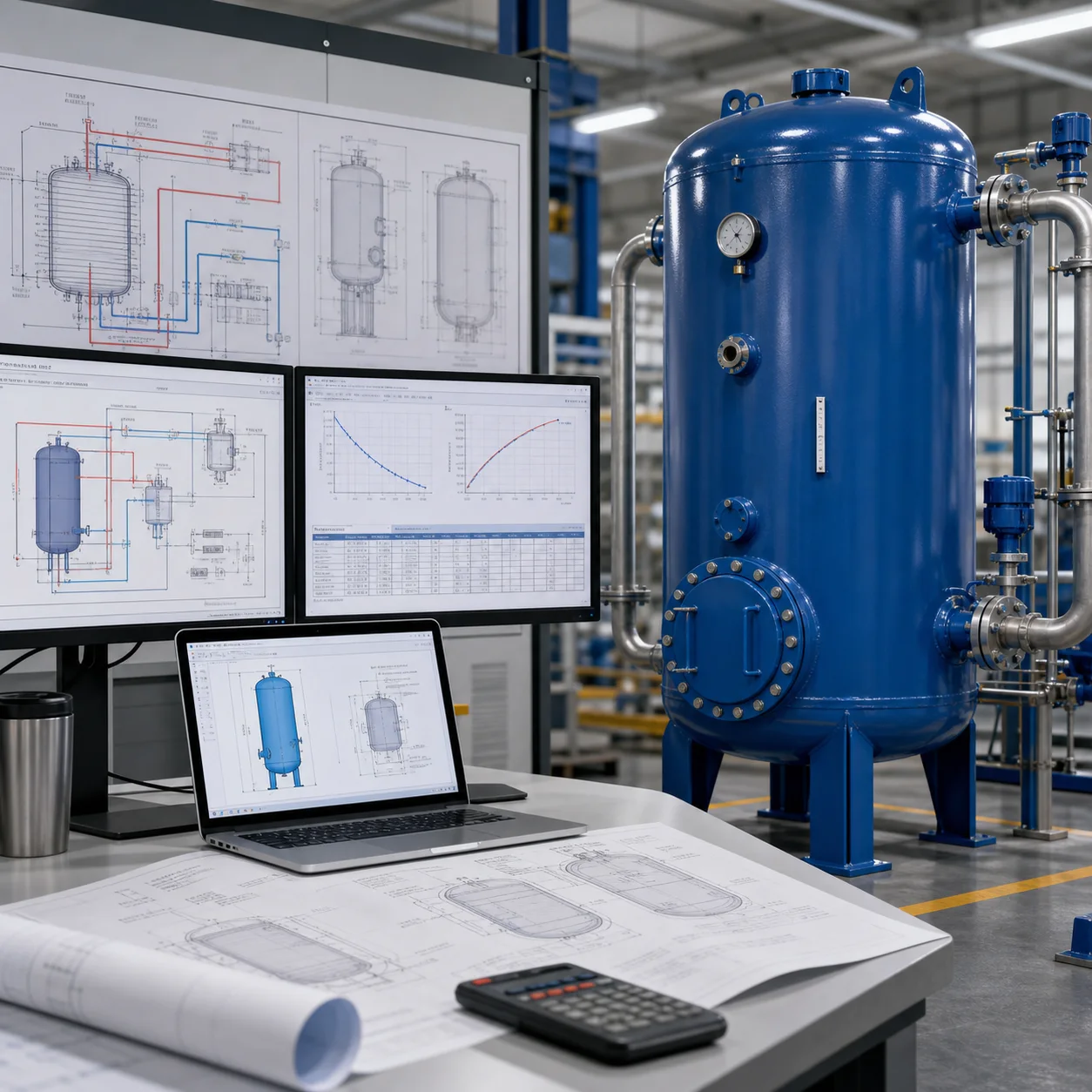
The selection logic is different from an instant exchanger. Engineers first define the peak draw-off profile and required recovery time, then match vessel volume, heat-transfer area, heat-source condition and pressure-vessel structure.
Buffer the Draw-Off Peak
Stored water volume covers short-term peak demand, such as hotel bathing, hospital domestic hot water or dormitory shower periods. This is the main reason to choose a volumetric storage exchanger instead of only an instantaneous exchanger.
Recover Heat Through Coils
Steam or primary hot water heats the stored water through internal coil surfaces. The floating-coil route described in Hengxin catalog is intended to improve heat-transfer behavior compared with a traditional volumetric exchanger.
Control Volume, Pressure and Layout
The final equipment is checked as a pressure-vessel hot-water device. Vessel orientation, DN, inspection opening, nozzles, supports, drain and vent positions must match the machine room and maintenance requirements.
Why Floating-Coil Storage Matters
More Stable Outlet Temperature
The storage volume slows the temperature drop during peak demand, while the coil area defines how quickly the vessel recovers after draw-off.
Lower System Shock
Compared with pure instantaneous heating, a volumetric body can reduce short cycling and abrupt load swings on the heat source.
Maintenance-Oriented Vessel Design
Inspection openings, drain points and coil access should be reviewed before fabrication because fouling and water quality affect long-term performance.
Applications for Peak Hot Water Demand
Storage-type heat exchangers are most useful when hot-water demand is intermittent, users need stable temperature, and the heat source should not be forced to follow every short peak instantly.
Hotels and Resorts
Bathing and kitchen demand often concentrates in short periods. Storage volume helps protect guest comfort during simultaneous water use.
Hospitals and Care Facilities
Hot-water supply stability matters for wards, sterilization support and daily facility use; system redundancy and sanitation requirements should be reviewed early.
Commercial Buildings
Shopping centers, gyms, schools and office complexes can use storage volume to manage predictable daily domestic hot-water peaks.
Industrial Hot Water
Used where process washing, batch cleaning or plant service water needs a buffer tank combined with heat-transfer recovery.
How to Select a Storage-Type Heat Exchanger
A reliable quotation needs both thermal data and storage-use data. Hengxin engineers should know not only the target temperature, but also how quickly users draw water and how quickly the tank must recover.
Hot-Water Demand Profile
Peak draw-off rate, peak duration, daily hot-water volume, simultaneous users and whether the load is continuous or batch-type.
Storage Volume and Recovery
Required vessel volume, initial tank temperature, allowable temperature drop and acceptable recovery time after a peak period.
Heat Source Conditions
Steam pressure and condensate return, or primary hot-water inlet/outlet temperatures, flow rate and available pressure drop.
Secondary Water Conditions
Cold-water inlet temperature, target outlet or tank set temperature, recirculation return temperature, water quality and scaling tendency.
Pressure and Code Boundary
Operating pressure, design pressure, pressure class, inspection requirement, safety valve arrangement and local pressure-vessel documentation.
Machine Room Layout
Vertical or horizontal layout, floor loading, lifting clearance, nozzle orientation, drainage, maintenance aisle and insulation space.
Catalog-Based Technical Data
The following values are summarized from Hengxin product manual sections for volumetric storage and volumetric floating-coil exchangers. Final sizing must be recalculated from project conditions and pressure-vessel requirements.
| Item | Catalog Information Confirmed From Product Manual |
|---|---|
| Product route | Volumetric storage vessel combined with floating-coil heat-transfer characteristics. |
| Typical configurations | Vertical and horizontal storage vessels; steam-water and water-water heating routes. |
| Catalog model families | SWRL / SWRW for steam-water storage units and WWRL / WWRW for water-water storage units in the listed tables. |
| Listed storage volume | 1.5, 2, 3, 4, 5, 6, 8 and 10 m³ are listed in the storage model tables. |
| Listed vessel diameter | DN1000, DN1200, DN1400, DN1600 and DN1800 appear across the 1.5-10 m³ model tables. |
| Heat-transfer area in storage model tables | Approximately 5.2-31.5 m² across listed vertical/horizontal steam-water and water-water storage models. |
| GZG-K performance table area | 3.41-39.40 m² in the catalog performance table for 50-65°C heated water conditions. |
| Pressure information | The storage model tables list 0.6 MPa tube-side pressure and model pressure classes of 0.6, 1.0 and 1.6 MPa in the suffixes. |
| Catalog pressure drop reference | GZG-K performance table lists shell-side pressure drop of 0.002-0.008 MPa under the stated catalog conditions. |
Representative GZG-K Steam-Water Performance Rows
These rows show the technical scale of the catalog data. They are not a universal sizing chart; the final unit depends on demand profile, heat source, pressure class, vessel volume and water quality.
| Model / Area | Heated Water Condition | Steam Condition | Catalog Output Data |
|---|---|---|---|
| GZG-K-3.41 / 3.41 m² | 50-65°C; hot-water flow 27.60 or 38.27 m³/h | Saturated steam pressure 0.2 or 0.4 MPa | Steam flow 786 or 1125 kg/h; heat output 414 or 574 x 10³ kcal/h |
| GZG-K-10.30 / 10.30 m² | 50-65°C; hot-water flow 83.27 or 118.20 m³/h | Saturated steam pressure 0.2 or 0.4 MPa | Steam flow 2370 or 3476 kg/h; heat output 1249 or 1773 x 10³ kcal/h |
| GZG-K-21.44 / 21.44 m² | 50-65°C; listed hot-water flow rows 174, 196 and 237 m³/h | Saturated steam pressure range 0.4-0.6 MPa | Steam flow rows 5019, 5653 and 6836 kg/h; heat output rows 2610, 2940 and 3555 x 10³ kcal/h |
| GZG-K-39.40 / 39.40 m² | 50-65°C; listed hot-water flow rows 297, 346 and 403 m³/h | Saturated steam pressure range 0.4-0.6 MPa | Steam flow rows 8567, 9980 and 11625 kg/h; heat output rows 4455, 5190 and 6045 x 10³ kcal/h |
Source note: the GZG-K table also states shell-side pressure drop of 0.002-0.008 MPa. OCR table extraction can shift columns, so Hengxin should confirm final model rows against the original product manual before issuing a formal quotation.
Installation, Operation and Maintenance Considerations
Storage-type exchangers are not only heat-transfer equipment; they are also large water-filled vessels. Installation planning should cover weight, access and water-quality management before the equipment is fabricated.
Foundation and Filled Weight
Storage models carry significant water mass. Check foundation loading, transport path, lifting points and the final filled weight before delivery.
Drain, Vent and Safety Devices
Drainage, venting, safety valve, temperature sensor and pressure gauge positions should be accessible after insulation and piping are installed.
Water Quality and Scaling
Domestic hot water and process water can scale internal surfaces. Hardness, chloride, suspended solids and cleaning method influence coil and vessel maintenance.
Recirculation Control
For domestic hot water, recirculation return temperature and pump logic affect tank stratification, recovery time and user-side temperature stability.
Manufacturing and Quality Support
Hengxin manufactures this product as a project-specific vessel and heat-transfer assembly. The engineering review should connect thermal sizing with mechanical layout, pressure class, weld quality, inspection access and shipment constraints.
FAQ
Common questions about Hengxin storage-type heat exchangers, including the technical route, model range, selection data and project information required for engineering quotation.
What is the difference between a storage-type heat exchanger and an instantaneous heat exchanger?
A storage-type heat exchanger includes vessel volume, so it can buffer peak hot-water demand and recover temperature through internal heat-transfer coils. An instantaneous exchanger is mainly sized to meet the load at the moment of use, with little or no storage buffer.
What storage volumes are listed in the Hengxin catalog?
The storage model tables list 1.5, 2, 3, 4, 5, 6, 8 and 10 m³ vessel volumes. Final volume selection depends on peak draw-off, recovery time, target water temperature and available heat source capacity.
Can Hengxin supply both steam-water and water-water storage exchangers?
Yes. The product manual lists steam-water and water-water storage configurations, with vertical and horizontal model families. Steam pressure, primary-water temperature, pressure class and site layout determine the final structure.
What data is needed for a storage-type heat exchanger quotation?
Hengxin needs peak and daily hot-water demand, cold-water inlet temperature, target water temperature, recovery time, steam or primary-water condition, operating/design pressure, water quality, vessel orientation, connection standard and machine room layout.
When should a vertical vessel be selected instead of a horizontal vessel?
Vertical vessels are usually considered when floor area is limited and the room height allows it. Horizontal vessels may be easier for certain installation, inspection or transport conditions. The final choice should account for foundation load, headroom, lifting access and maintenance space.
Are the catalog tables enough for final sizing?
No. The catalog tables provide model and performance references. Final sizing should be recalculated from actual heat duty, demand profile, heat-source condition, pressure class, fouling allowance and pressure-vessel requirements.