
Water-to-Water Heat Exchange System
Hengxin’s HX-JZ-S water-to-water system is a skid-mounted heating station built around plate heat exchangers, circulation pumps, make-up pressure pumps, dirt separation, instruments, valves and an electric control cabinet.
- Catalog system family: HX-JZ-S water-water unit, with HX-JZ-W intelligent unattended control option
- Catalog design envelope for HX-JZ units: maximum design temperature <=300 deg C and maximum design pressure 2.5 MPa
- Designed for primary and secondary water loops in CHP, residential district heating and urban centralized heating stations
A Complete Water-to-Water Heating Station, Not Only a Plate Exchanger
The product sample describes the HX-JZ series as equipment for combined heat and power, residential district heating and centralized heating. The water-water version separates the primary network and the secondary network through plate heat exchangers, then integrates pumps, make-up pressure, filtration and controls on one skid.
For quote comparison, define whether you need a plate heat exchanger only, a heat exchanger unit, or a complete water-water heat exchange station scope. Pumps, make-up pressure, dirt separation, cabinet logic and remote monitoring often change the real project value more than exchanger area alone.
How the Primary and Secondary Water Loops Work
A water-to-water station transfers heat from the primary network to the secondary network without mixing the two circuits. That loop separation is why the station can control building-side supply temperature, pressure and flow while the primary network remains isolated.
Plate Heat Transfer With Station-Level Control
The catalog drawing marks primary-network inlet and outlet, secondary-network inlet and outlet, and make-up water inlet. In a typical Hengxin layout, plate heat exchangers sit with circulating pumps, a make-up pressure system, dirt separator, instruments, valves and a control cabinet on the same base frame.
The engineering value is not only heat transfer area. The skid gives the heat station a controllable secondary side: supply temperature regulation, variable-flow circulation, make-up pressure control, fault alarms and optional remote communication.
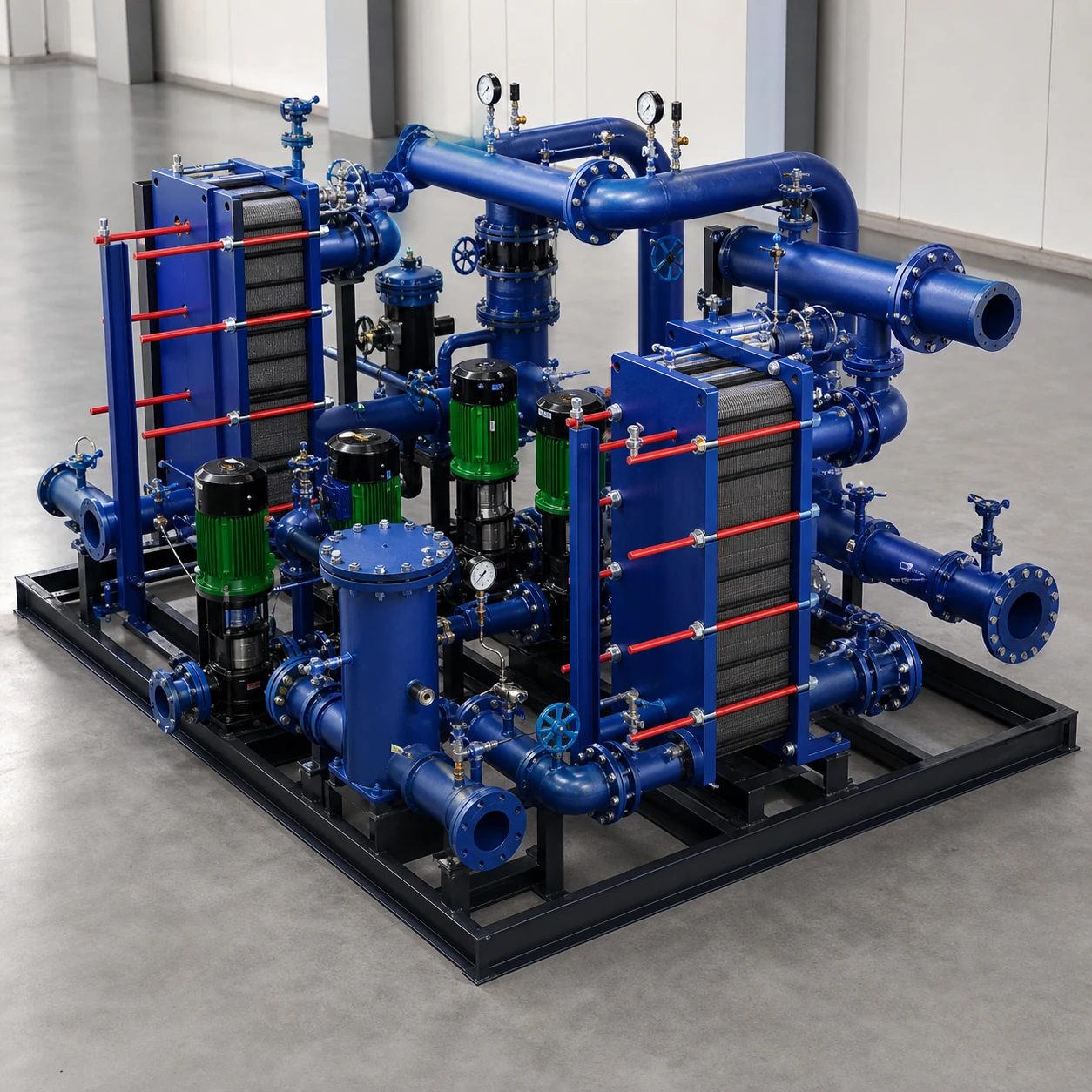
Heat-network water enters the primary side of the station.
Heat is transferred across the plates while the two loops remain separated.
Circulation pumps deliver heated secondary water to the building or district loop.
Make-up pumps stabilize return pressure and compensate system water loss.
Temperature, pressure and flow signals drive valves, pumps and alarms.
System Configurations Hengxin Can Build
The same water-water station concept can be supplied as a conventional heat exchange unit or as an intelligent unattended station. The project scope should be defined before selection so pumps, valves, cabinet and communications are not treated as afterthoughts.
HX-JZ-S Water-Water Unit
Skid-mounted water-water station with exchanger, circulating pump, make-up pressure pump, dirt separator, electric control cabinet, automatic instruments, pipes and valves.
HX-JZ-W Intelligent Unit
Unattended control upgrade with PLC, variable-frequency drives, temperature sensors, pressure sensors and automatic control valves.
Project-Specific Skid Layout
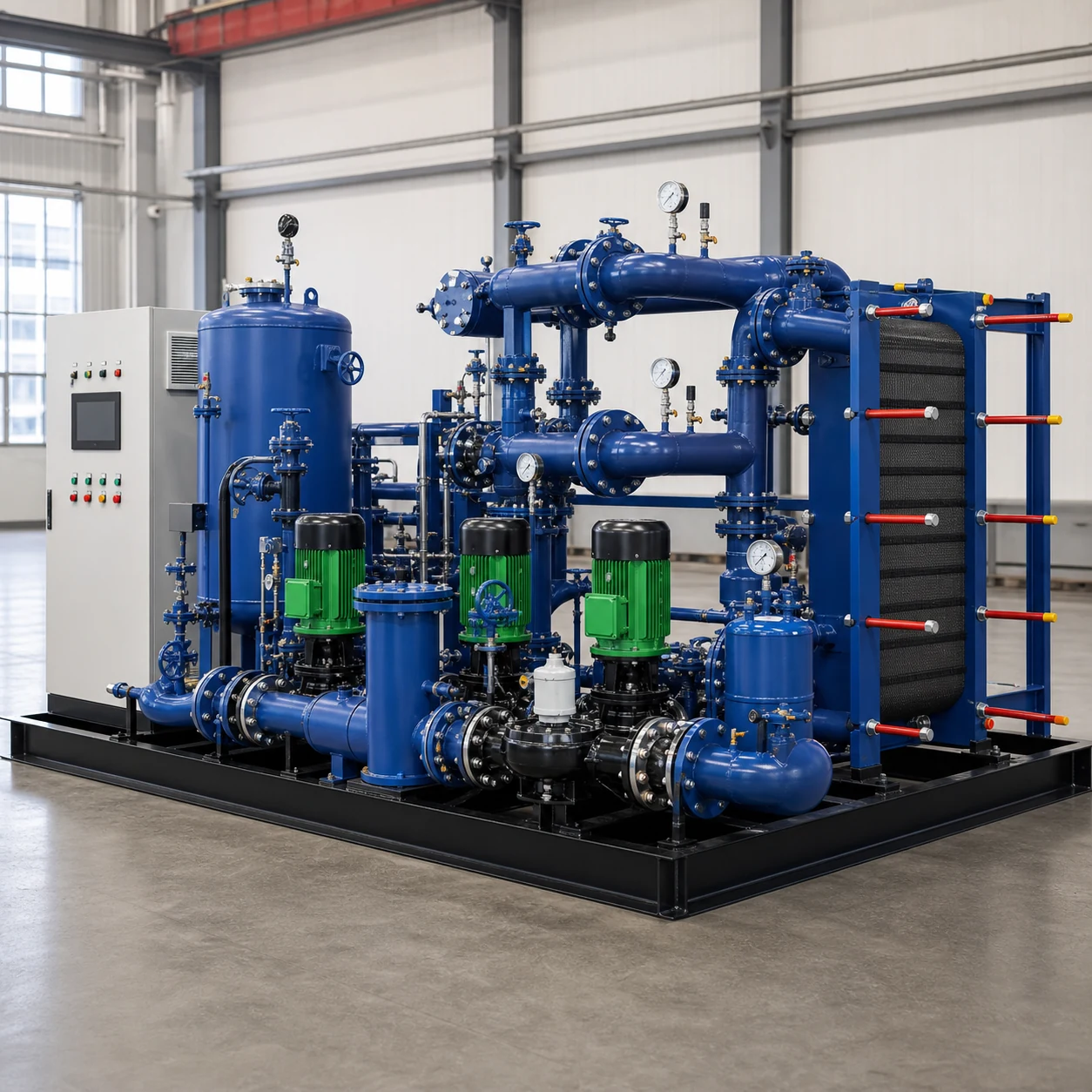
Connection orientation, plate exchanger capacity, pump redundancy, tank and cabinet position can be arranged around the equipment room and pipe interface.
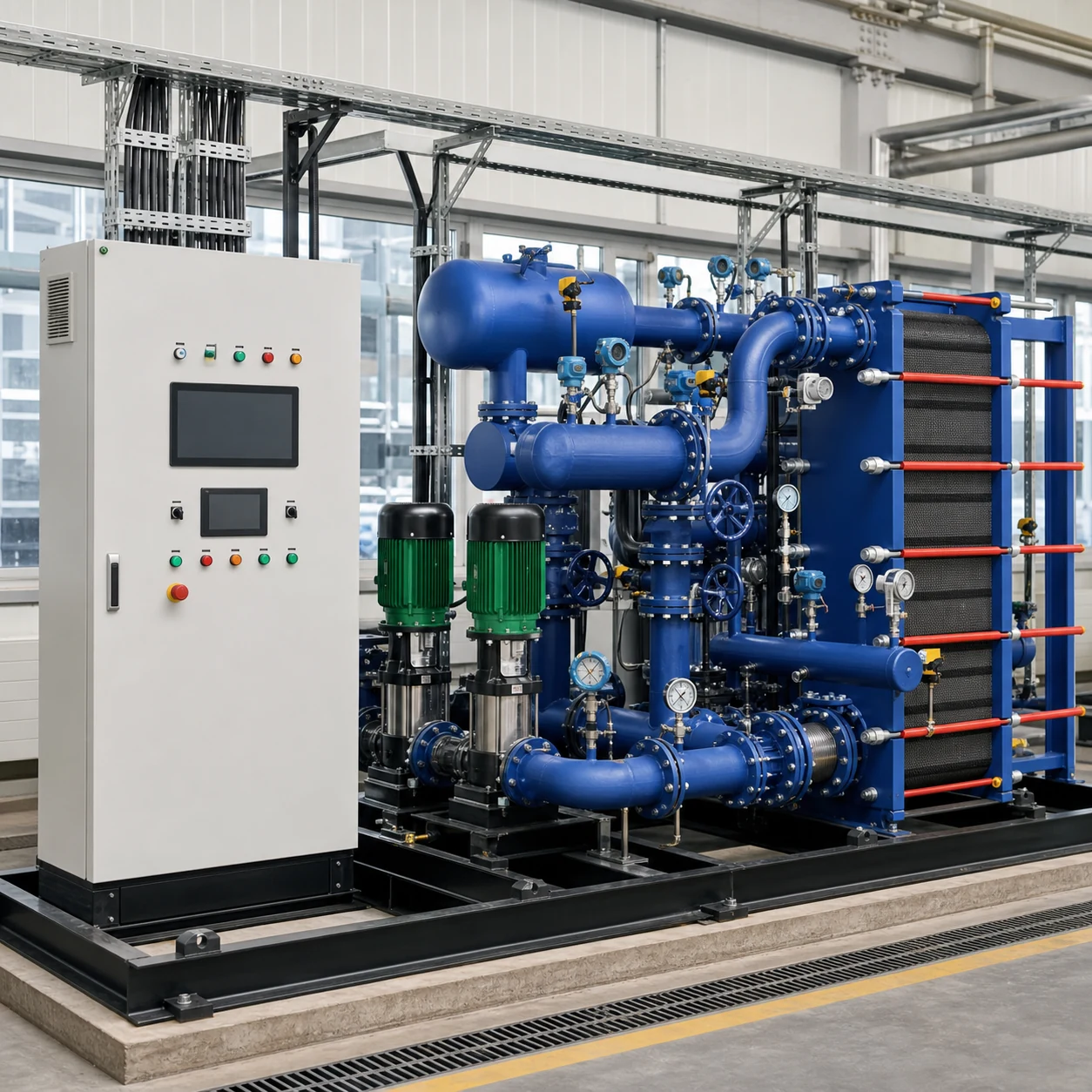
Control Cabinet and Pumps Are Part of the Product Scope
For procurement, a water-water station should be compared as a working heat station, not as a loose plate exchanger price. Pump frequency control, make-up pressure, valve authority, instrument signals and cabinet logic determine whether the station can run stably during seasonal load changes.
Hengxin can configure the system from a basic skid to a remote-monitored unattended station, depending on whether the buyer needs local automatic control, central dispatch or BAS connection.
Applications for Water-Water Heating Projects
The catalog places HX-JZ units in heating stations where primary hot water must serve a secondary loop with independent temperature, pressure and flow control.
District Heating Substations
Primary network to secondary building loop exchange for urban centralized heating networks.
Residential Communities
Skid-mounted secondary-side heating supply for residential compounds and community heating rooms.
CHP and Heat-Source Stations
Water-water separation for combined heat and power projects and heat network transfer stations.
Public and Industrial Buildings
Heating loops for campuses, hospitals, offices and compatible process hot-water systems.
Selection Data Hengxin Needs Before Quotation
A water-water station should be selected from the heat load and both loop conditions. Send these details so Hengxin can size the plate exchanger, pumps, control valve and cabinet functions together.
Technical Data and Catalog-Backed Notes
The table keeps the catalog data separate from engineering interpretation, so buyers can see which claims are sample-backed and which items still need project selection.
| Item | Catalog Information | Engineering Meaning for Buyers |
|---|---|---|
| Product family | HX-JZ-S water-water heat exchange unit; HX-JZ-W intelligent fully automatic unattended heat exchange unit. | Use HX-JZ-S for standard water-water station scope and HX-JZ-W when unattended control is required. |
| HX-JZ components | Heat exchanger, circulating pump, make-up pressure pump, dirt separator, electric control cabinet, automatic instruments, pipes and valves. | Station selection must include hydraulic, control and integration scope, not only exchanger area. |
| Design envelope | Maximum design temperature <=300 deg C; maximum design pressure 2.5 MPa for the HX-JZ unit family. | Use as catalog-level screening data. Final ratings follow project pressure, temperature and code requirements. |
| Water-water flow paths | Catalog drawing labels primary-network inlet/outlet, secondary-network inlet/outlet and make-up water inlet. | Confirms separated primary and secondary circuits with a make-up pressure interface on the skid. |
| Temperature control | Outdoor temperature compensation and primary-side electric regulating valve control secondary-side supply temperature. | Useful for district heating systems that need stable supply temperature under changing outdoor load. |
| Pump control | Circulation pump can use variable-frequency control based on secondary-side supply/return pressure difference or temperature difference. | Supports variable-flow operation and "large temperature difference, small flow" energy-saving operation. |
| Make-up pressure | Make-up pump can use variable-frequency control based on secondary-side return pressure; tank level sensor can control water tank level with low-level protection. | Prevents unstable secondary pressure and protects the make-up water system. |
| Remote communication | Optional wired communication such as telephone dial-up, ADSL or broadband, and wireless GPRS; supports Ethernet, PPP and TCP/IP protocols. | Allows central management station or BAS integration when remote operation is required. |
Control and Unattended Operation Logic
The strongest selling point of the water-water system is the control package. The catalog does not just list a plate exchanger; it describes temperature compensation, pump frequency control, pressure protection, remote communication and central monitoring.
From Local Control to Remote Heat-Network Dispatch
The unattended control option can upload primary and secondary temperatures, pressures, flow, outdoor temperature, indoor temperature, circulation pump and make-up pump operating status, pump frequency and electric valve opening to a central management station or BAS.
Alarm and protection functions include high supply temperature alarm, low return pressure alarm, low water tank level alarm, supply pressure overpressure alarm, automatic overpressure relief, power-off automatic protection and linkage logic.
Manufacturing and Integration Capability
For a water-water system, factory integration reduces site coordination risk. Hengxin can build the exchanger, pumps, headers, separator, cabinet and instrument interfaces into a practical skid layout before delivery.
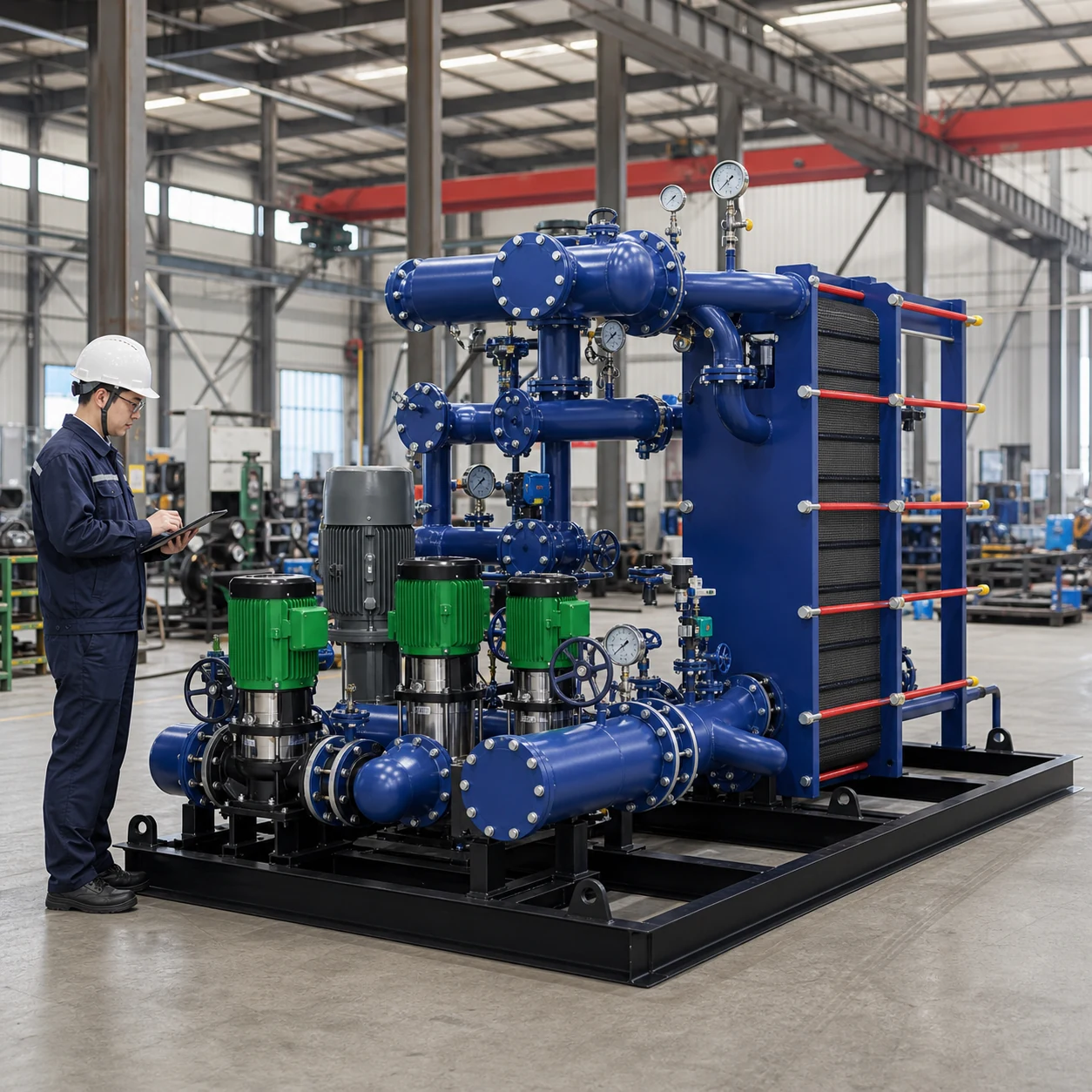
Factory Skid Instead of Loose Components
A practical water-water station brings the plate exchanger, blue headers, circulation pumps, valves and instruments onto one base frame, so the equipment can be installed as a coordinated heating-station package.
Before delivery, the skid layout should be checked against pipe entry direction, cabinet access, maintenance clearance, pump service space and lifting conditions in the equipment room.
FAQ
Common engineering questions about Hengxin water-to-water heat exchange systems and HX-JZ-S/HX-JZ-W heating stations.
What is a Hengxin water-to-water heat exchange system?
It is an HX-JZ-S water-water heat exchange unit that transfers heat from a primary water network to a secondary water loop through plate heat exchangers, with pumps, make-up pressure, dirt separation, instruments, valves and a control cabinet integrated on a skid.
How is it different from buying only a plate heat exchanger or heat exchanger unit?
A plate exchanger is only the heat-transfer core. Hengxin's HX-JZ-S is a complete water-water heat exchange unit, or heat exchange station, because it can include circulation pumps, make-up pressure pump, dirt separator, control cabinet, instruments, pipes and valves. Buyers should define exchanger-only supply, a packaged heat exchanger unit or a complete station scope before quotation.
What are the catalog design limits for the HX-JZ unit family?
The Hengxin product sample states that HX-JZ series units have a maximum design temperature of <=300 deg C and a maximum design pressure of 2.5 MPa. Final equipment ratings must still follow the selected model and project documents.
Can the system run unattended?
Yes. The HX-JZ-W intelligent unattended option can add PLC, VFD, temperature sensors, pressure sensors and automatic valves for supply temperature regulation, pressure control, fault protection and remote communication.
What remote monitoring data can be uploaded?
The catalog lists primary and secondary temperatures, pressures, flow, outdoor temperature, indoor temperature, circulation pump and make-up pump operating status and frequency, plus electric regulating valve opening. These can be sent to a central management station or BAS when configured.
What project data is needed for selection?
Send primary and secondary water temperatures, flow, pressure, heat load, pressure drop limits, pump redundancy needs, control requirements, water quality, site layout, pipe directions and whether remote monitoring or BAS communication is required.
Which applications are most suitable?
Typical applications include district heating substations, residential community heating, CHP heat exchange stations, public building heating loops and compatible industrial hot-water systems that need separated primary and secondary water circuits.
Why is water quality still important?
The station uses plate heat exchangers and circulating water loops. Hardness, suspended solids, chloride and scaling tendency affect plate material, gasket choice, dirt separation, cleaning interval and long-term pressure drop.
Request a Water-to-Water System Selection
Send primary and secondary water temperatures, flow rate, heat load, working pressure, pressure drop limit, pump/control scope and equipment-room constraints. Hengxin will review whether you need an HX-JZ-S water-water unit or an HX-JZ-W intelligent unattended station.
For fast evaluation, include site layout limits, control cabinet requirements and remote monitoring expectations. These affect nozzle orientation, pump selection, valve authority, cabinet logic and commissioning scope.