
Intelligent Fully Automatic Unattended Heat Exchange System
Hengxin builds unattended heat exchange stations by integrating steam-to-water or water-to-water heat exchange units with PLC control, sensors, control valves, VFD pumps, electric cabinet, HMI and remote monitoring.
- Base unit can be an HX-JZ-Q steam-water system or an HX-JZ-S water-water system.
- Intelligent package adds PLC, VFD, temperature and pressure sensors, automatic valves and cabinet logic.
- Designed for heat stations that need automatic temperature control, pressure control, alarms and remote communication.
Product Understanding: Control System Added to the Heat Exchange Unit
This product is not a single heat exchanger core. It is a complete heat exchange station built around Hengxin HX-JZ steam-water or water-water units, then upgraded with automatic control hardware and remote monitoring functions.
Base Heat Exchange Unit
Heat exchanger, circulation pump, make-up pressure pump, dirt separator, pipes and valves form the operating station body.
Intelligent Control Package
PLC, VFD, temperature sensors, pressure transmitters and automatic regulating valves turn the station into an automatic control system.
Remote Management Layer
Communication can upload operating data to a central station or connect with BAS when remote monitoring is required.
System Architecture
The architecture should be selected as one package. If the buyer treats the control cabinet, pumps, valves and sensors as separate afterthoughts, the station may miss valve authority, feedback signals or remote data points required for unattended operation.
Mechanical, Instrumentation and Control Layers
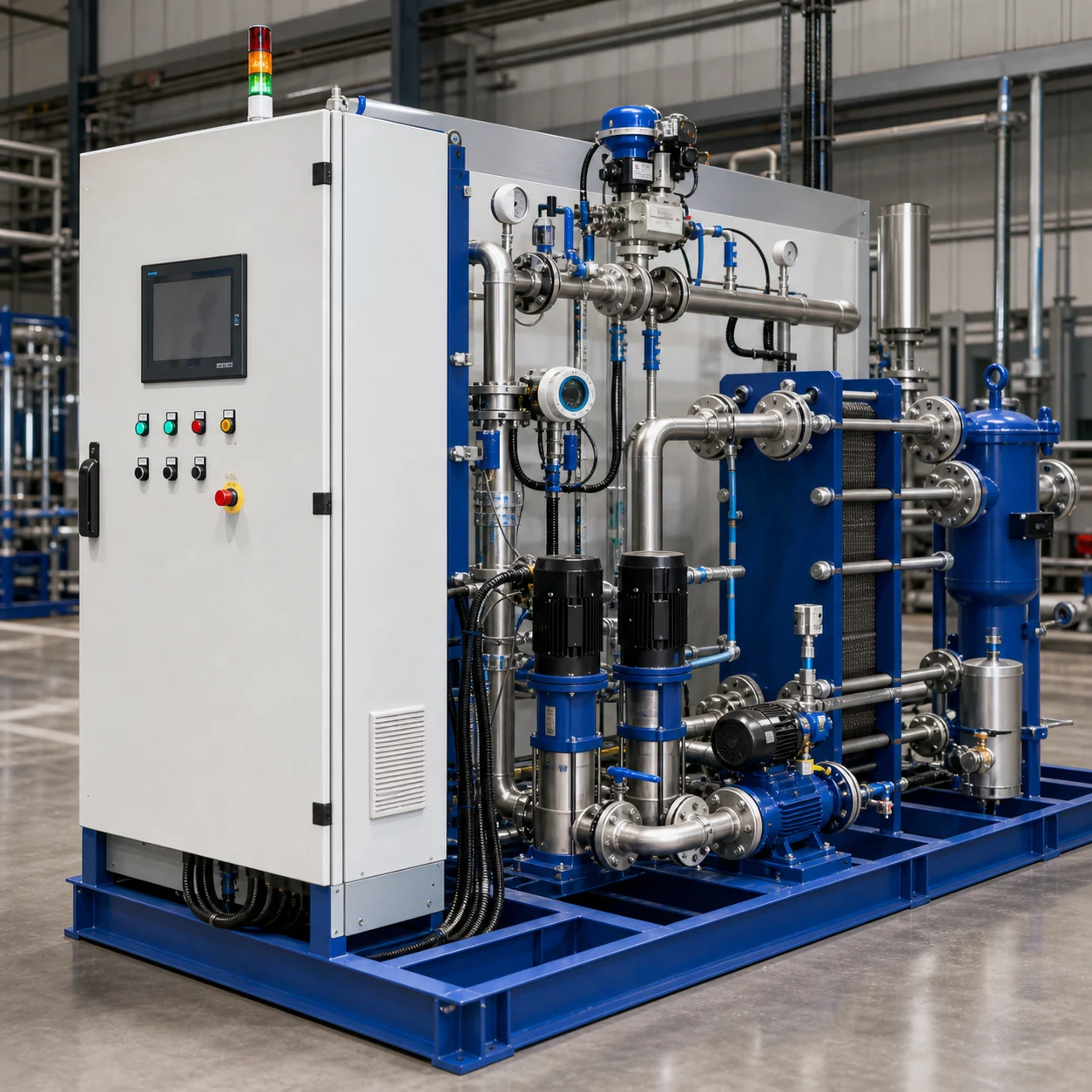
Control cabinet, instruments, pumps and heat exchanger are selected together for unattended station duty.
Control Logic for Unattended Operation
The control system is the main difference from a conventional heat exchange unit. The catalog describes temperature compensation, pump frequency control, make-up pressure control, liquid-level protection, alarms, automatic relief and remote communication.
Outdoor temperature and the set compensation curve can control the primary electric regulating valve to maintain secondary supply temperature.
Secondary supply-return pressure difference or temperature difference can be used as feedback for VFD pump control and variable-flow operation.
Secondary return pressure can drive VFD make-up control; tank level sensing supports automatic level control and low-level protection.
Primary/secondary temperature, pressure, flow, pump status/frequency and regulating valve opening can be uploaded to a central station or BAS.
Alarm Protection
Supply temperature high alarm, return pressure low alarm, tank low-level alarm and supply pressure overpressure alarm are listed in the source material.
Automatic Relief
A solenoid relief valve can be added on the secondary return line. When pressure exceeds the set value, it opens until pressure returns to a safe value.
Power-Off Protection
The catalog lists power-off automatic protection and linkage functions for safer unattended operation.
Remote Setting
Through two-way communication between the monitoring center and site controller, operating parameters can be optimized remotely.
Applications for Intelligent Heat Exchange Stations
Use this system when the project needs more than heat transfer area. It is suited to stations where operators want automatic temperature and pressure control, alarm handling, remote data and reduced daily attendance.
Heating Stations
Community or building substations requiring automatic secondary-side supply temperature and pressure control.
Domestic Hot Water
Hot-water preparation stations where outlet temperature stability, alarms and pump control need to be integrated.
District Heating
Centralized heating networks, CHP projects and heat transfer stations that need centralized monitoring or BAS connection.
Industrial Hot Water
Compatible industrial hot-water systems selected by medium, heat load, water quality, pressure and process control requirements.
Unattended Heat Stations
Projects where the station starts and runs by preset program, while operators perform scheduled inspection rather than continuous attendance.
Station Retrofit
Existing heat exchange stations that need upgraded sensors, regulating valves, VFD pumps, cabinet logic and remote communication.
Water-Water Systems
Primary network water to secondary loop water stations requiring separated loops and intelligent control.
Steam-Water Systems
Steam-source stations where the base equipment and control valve strategy must be matched to steam pressure and condensate handling.
Selection Data Hengxin Needs Before Quotation
Selection starts with the heat source and the controlled secondary-side demand. The control scope must be defined with the mechanical station so Hengxin can size the heat exchanger, pumps, regulating valves, sensors, cabinet and communication functions together.
Technical Components and Functions
The table separates the heat-transfer equipment from control, measurement and protection components, so buyers can specify what should be included in the station package.
| Component | Function in the Intelligent System | Selection Notes |
|---|---|---|
| Heat exchange unit | Transfers heat between steam-water or water-water circuits. | Select HX-JZ-Q steam-water, HX-JZ-S water-water or project-specific station scope. |
| Circulation pump | Maintains secondary-loop circulation; can be VFD controlled by pressure difference or temperature difference feedback. | Confirm flow, head, redundancy and frequency-control requirement. |
| Make-up pressure pump | Maintains secondary return pressure and supports automatic make-up water. | Can use VFD control based on secondary return pressure. |
| Temperature sensors | Measure supply/return, outdoor and optional indoor temperatures for control and monitoring. | Outdoor compensation is used for secondary supply temperature control. |
| Pressure transmitters | Provide pressure feedback for pump control, pressure protection and remote data upload. | Define primary and secondary pressure points before cabinet design. |
| Electric regulating valve | Controls primary-side heat input to maintain secondary supply temperature. | Valve sizing must match heat load, pressure drop and control authority. |
| PLC and HMI | Run preset control programs, display operating screens and support local operation. | The source mentions Siemens intelligent control system; final brand/scope can be project-defined. |
| VFD | Controls circulation pump and make-up pump speed for variable-flow and pressure-control operation. | Specify which pumps need frequency conversion and feedback signals. |
| Electric control cabinet | Integrates control hardware, protection, wiring, local display and operation interface. | Confirm voltage, cabinet environment, I/O list and communication ports. |
| Flow meter / heat meter | Measures flow and heat data for monitoring, reports or heat-station management. | Confirm whether project requires metering output to central station or BAS. |
| Solenoid relief valve | Can release secondary return pressure automatically when pressure exceeds the set value. | Use when overpressure relief logic is required by the station design. |
| Remote communication | Uploads temperature, pressure, flow, pump status/frequency and valve opening for online monitoring. | Catalog options include telephone dial-up, ADSL/broadband and GPRS; protocols include Ethernet, PPP and TCP/IP. |
Catalog-backed HX-JZ family limits: maximum design temperature <=300 deg C and maximum design pressure 2.5 MPa. Final ratings depend on selected exchanger, pump, valve, cabinet and project documents.
Manufacturing, Quality and Delivery
An unattended station should be delivered as a coordinated engineering package, not loose components. Hengxin reviews the thermal duty, hydraulic layout, control points, cabinet logic and installation constraints before production.
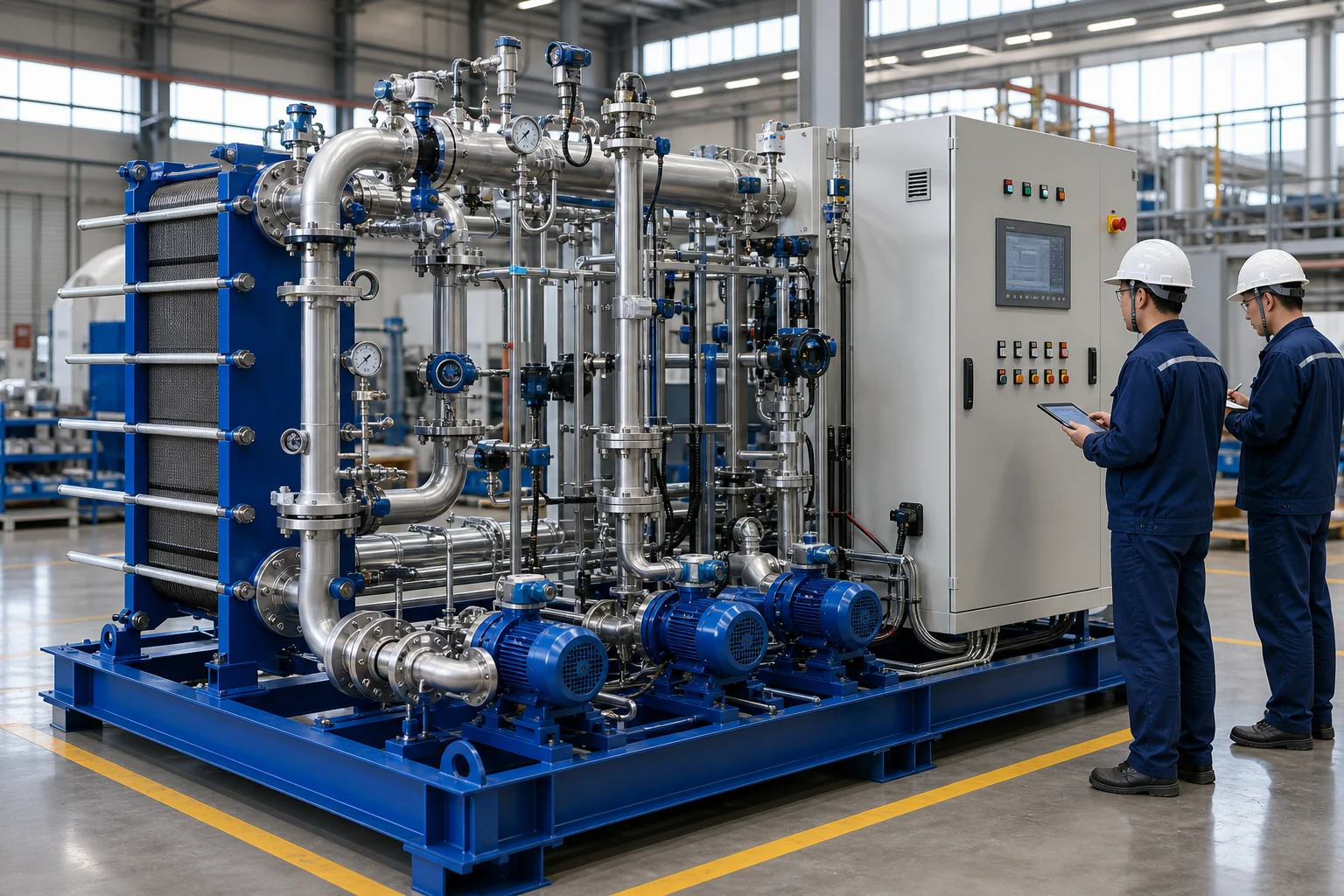
Factory-integrated station layout reduces site coordination between exchanger, pumps, valves and cabinet.
What Hengxin Can Customize
FAQ
Common engineering questions about Hengxin intelligent fully automatic unattended heat exchange systems.
What is an intelligent fully automatic unattended heat exchange system?
It is a complete HX-JZ heat exchange station based on a steam-to-water or water-to-water unit, upgraded with PLC, VFD, temperature and pressure sensors, automatic valves, electric control cabinet, alarm protection and remote communication for unattended operation.
How is it different from a normal steam-water or water-water heat exchange unit?
A normal unit focuses on the heat exchanger, pumps, pipes and valves. The intelligent unattended system adds the control layer: PLC logic, VFD pump control, sensor feedback, automatic regulating valves, alarms, protection and remote monitoring.
Can the unattended control system be used with both steam-water and water-water units?
Yes. The intelligent package is a control and automation layer for HX-JZ steam-water or water-water heat exchange units. Hengxin selects the base exchanger and pump/valve station first, then defines PLC, VFD, sensors, HMI, alarms and remote communication.
What can the system automatically control?
The catalog-backed functions include secondary supply temperature regulation through the primary electric regulating valve, pressure control, VFD circulation pump control, VFD make-up pump control, tank level control, low-level protection, alarm protection and automatic overpressure relief when configured.
What remote data can be monitored?
The source material lists primary and secondary temperature, pressure, flow, outdoor temperature, indoor temperature, circulation pump and make-up pump operating status, pump frequency and electric regulating valve opening. These can be sent to a central management station or BAS when the communication scope is included.
What communication options are available?
The catalog lists wired telephone dial-up, ADSL and broadband communication, plus wireless GPRS. It also mentions Ethernet, PPP and TCP/IP protocol support. Final communication method should be confirmed with the site network and central monitoring requirements.
What information is needed for quotation?
Send heat load, heat source type, primary and secondary media, flow, inlet and outlet temperatures, pressure, control accuracy, pump and valve configuration, electrical cabinet requirements, remote monitoring requirements, water quality and equipment-room dimensions.
Can Hengxin customize the PLC, sensors, pumps and valves?
Yes. Hengxin can configure the exchanger, pumps, control valves, transmitters, cabinet I/O, HMI and communication according to the project duty. The exact component brands, redundancy and control points should be defined during technical selection.
Which projects are suitable for unattended heat exchange stations?
Typical applications include heating stations, domestic hot water systems, district heating substations, CHP heat exchange stations, industrial hot-water systems and existing heat station retrofits that need automatic control, alarms and remote monitoring.
Request an Intelligent Unattended System Selection
Send the heat load, steam-water or water-water basis, temperature and pressure conditions, pump/valve scope, control cabinet requirements and remote monitoring needs. Hengxin will review the base heat exchange unit and intelligent control package together.
For faster quotation, include the equipment-room size, pipe connection direction, available power supply, BAS or central monitoring interface and required alarm/protection points.