
Integrated Steam-to-Water Exchanger
A factory-integrated steam-to-water heat exchange unit built around Hengxin’s tubular-plus-plate exchanger, with skid piping, pumps, valves, instruments and control scope configured by project.
- Steam-to-water heat transfer with an upper tubular steam section and gasketed plate section
- Integrated skid/unit delivery reduces site piping, installation work and interface uncertainty
- Control cabinet, sensors, pumps and condensate handling are selected according to project scope
Product Understanding: Integrated Exchanger, Skid and Steam-Water Unit
This page is for buyers who need more than a loose exchanger body. Hengxin’s integrated steam-to-water exchanger is a project-defined steam-water heat exchange unit: the core heat exchanger is combined with a skid/frame, interconnecting piping and selected steam-side, water-side, condensate-side, instrument and control components.
An integrated configuration is different from a standard steam-to-water heat exchange system page because the purchasing scope is wider: the buyer is defining what arrives from the factory as a complete unit, which interfaces remain for the site contractor, and how the steam, secondary water and condensate connections are arranged. This also lets a buyer specify exchanger-only supply, a skid-mounted integrated unit or a complete heat exchange station package before comparing quotations.
Working Principle: Steam Side, Water Side and Condensate Side
The integrated unit keeps the same Hengxin steam-water heat-transfer principle, then packages the necessary station components around it according to the project interface.
Staged Steam Conditioning Before Plate Heat Transfer
The source catalog describes Hengxin’s steam-water exchanger as a combined structure. A compact tubular exchanger is mounted above the plate exchanger. Steam enters the tubular section first; after its pressure and temperature are reduced, it passes into the plate section for efficient water heating.
This matters because ordinary plate heat exchanger gaskets age faster when saturated steam is above 0.2 MPa and 130°C. The tubular section handles the first steam load, while the plate section keeps the heat-transfer density, compact footprint and maintenance access that buyers expect from a plate exchanger.
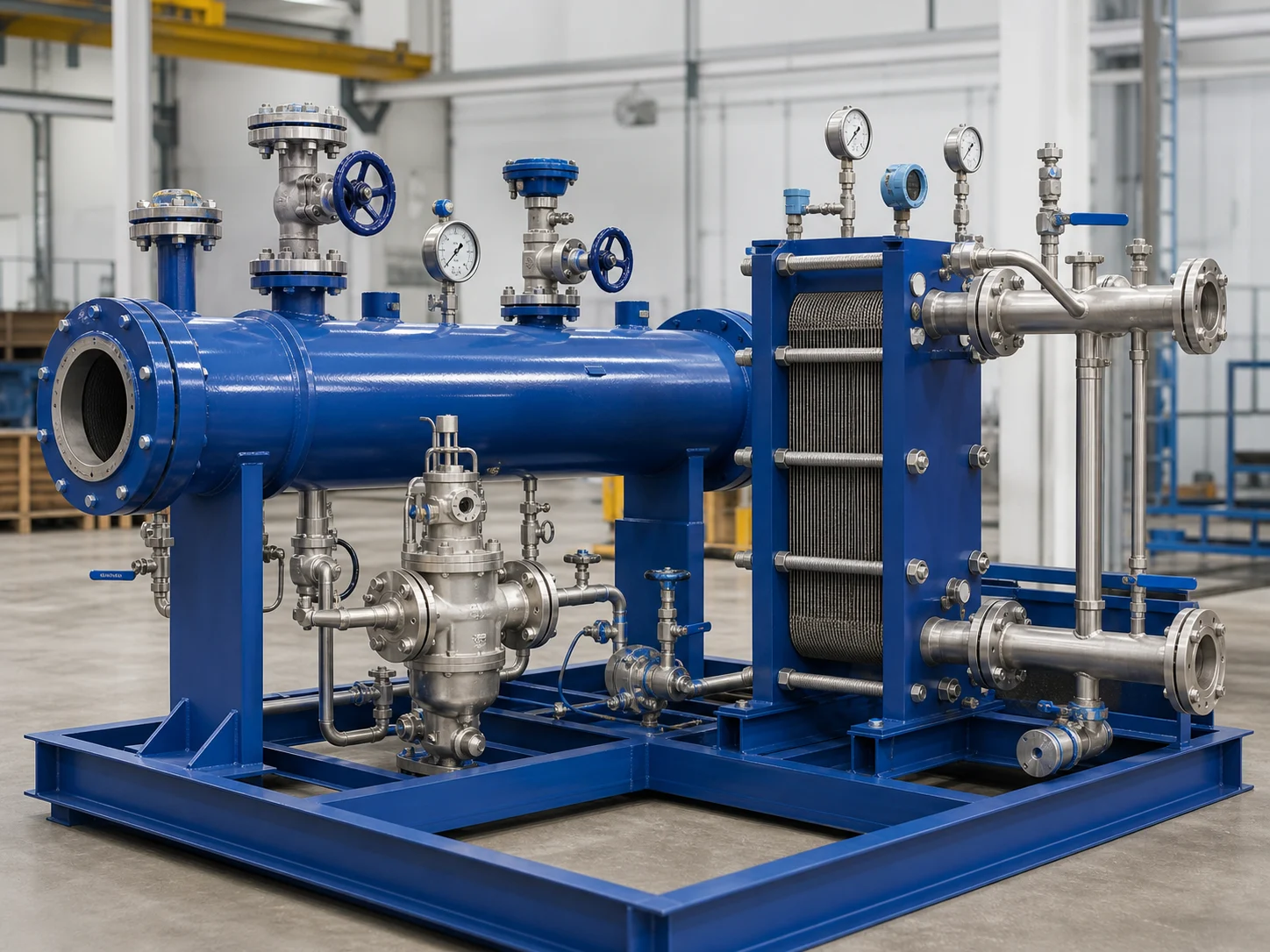
Steam enters the upper tubular section instead of directly loading the plate gaskets.
The tube section reduces the steam-side condition before the plate stage.
Secondary water is heated through the compact gasketed plate section.
Temperature control valve, sensors and cabinet are selected by the required automation level.
Condensate outlet and return/drain arrangement are confirmed from site data.
System Composition and Project-Defined Integration
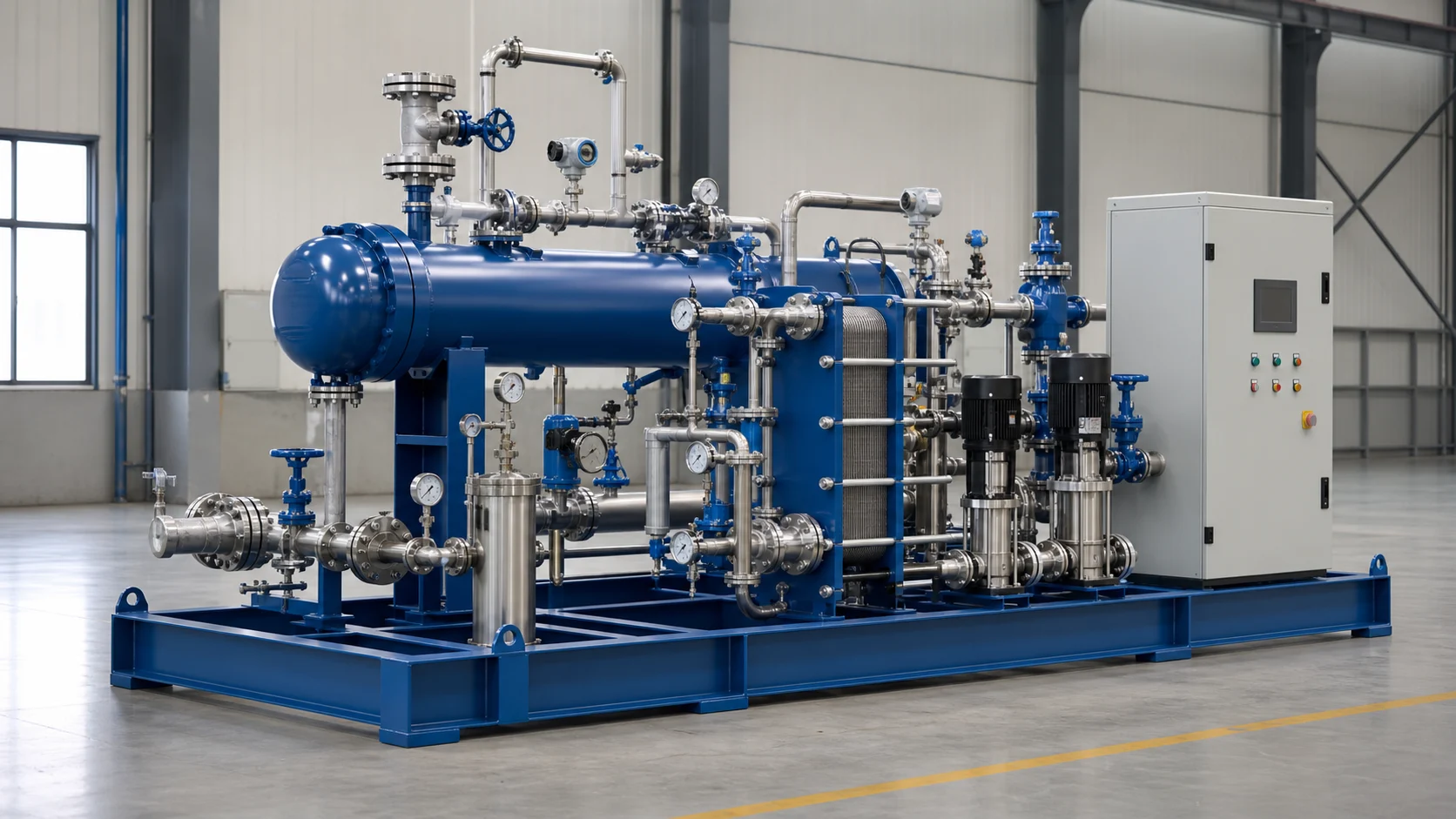
The catalog-backed HX-JZ unit scope includes the exchanger, circulating pump, make-up pressure pump, dirt separator, electric control cabinet, automatic instruments, pipes and valves. The exact integrated scope is confirmed before production.
Heat Exchanger Body
Upper tubular steam section plus gasketed plate exchanger. The catalog notes BR or BRB plate exchanger options and EPDM gasket material for the plate section.
Steam and Condensate Side
Steam inlet connection, project-defined control valve, shut-off valves, pressure/temperature instruments and condensate outlet or return interface.
Water Side and Pumps
Secondary water inlet/outlet, circulating pump, make-up pressure pump, dirt separator, branch piping and valves according to flow rate and site interface.
Control and Instrumentation Scope
For standard integrated units, Hengxin can package field instruments and an electric control cabinet around the exchanger and pump group. Temperature control through a primary-side electric regulating valve is available when project data supports it.
Unattended operation is not assumed by default. PLC, VFD pump control, outdoor temperature compensation, alarm protection and remote communication are optional control layers similar to HX-JZ-W intelligent systems.
Engineering Advantages of Choosing the Integrated Configuration
Buyers choose an integrated steam-water unit when the project risk is not only heat-transfer sizing, but also equipment-room layout, piping interfaces, controls and delivery completeness.
Reduced Site Installation
Skid piping, valves, instruments and pump interfaces can be pre-arranged at the factory, reducing field assembly and coordination work.
Compact Equipment Room Layout
The tubular-plus-plate structure keeps the steam duty compact, while the integrated skid defines nozzle positions and maintenance clearance early.
Clear Control Interface
Temperature sensor points, control valve scope, cabinet interface and optional BAS/remote signals are defined before delivery instead of solved late on site.
Stable Operation Logic
Startup sequencing, condensate drainage, bypass needs and pump/control interlocks can be reviewed as one heat exchange unit.
Complete Procurement Scope
The purchaser can compare exchanger-only supply against a unit package that includes pumps, instruments, valves, control cabinet and documentation.
Maintenance Access
Factory layout can reserve access to the plate section, pump group, steam-side valves and condensate outlet for inspection and servicing.
Applications for Integrated Steam-to-Water Units
The catalog lists steam-heated residential communities, hotels, enterprises, institutional heating, bathing and industrial hot-water applications. Integrated delivery is especially useful where site installation time or equipment-room space is limited.
Heating Stations
Steam-to-water conversion for secondary heating loops in heat exchange stations and equipment rooms.
Domestic Hot Water
Hotel, bathing, campus and public-building hot water where steam is available as the heat source.
District Heating
Residential community, centralized heating and combined heat-and-power support projects using steam source conditions.
Industrial Hot Water
Process hot-water preparation or compatible medium heating after the actual medium and water quality are reviewed.
Retrofit Projects
Equipment-room upgrades where compact layout, pre-defined nozzles and reduced site piping help shorten installation time.
Factory-Delivered Skids
Projects that prefer a packaged unit with skid frame, piping, pumps, instruments and cabinet interface instead of field-built assembly.
Centralized Heat Supply
Urban heating or enterprise heat supply systems where steam is converted to controlled secondary hot-water supply.
Project Customization
Interface direction, pump configuration, control level and condensate handling adapted to the plant-room layout.
Selection Data Hengxin Needs Before Quotation
Integrated steam-to-water units must be selected from real site data. The data below decides heat-transfer area, pump capacity, valve size, control method, condensate arrangement and skid dimensions.
Technical and Components Table
The table separates catalog-supported components from project-defined options, so buyers can specify the supply boundary clearly.
| Component / Data Point | Role in the Integrated Unit | Configuration Note |
|---|---|---|
| Core heat exchanger | Tubular steam section plus gasketed plate heat exchanger for staged steam-water heat transfer. | Catalog-supported base structure. |
| Catalog steam range | 0.1-0.8 MPa steam; product overview lists 120-180°C and the model-table note lists 110-180°C. | Use as screening data; final duty is calculated from project conditions. |
| Plate exchanger section | Compact heat-transfer surface for secondary water heating after steam-side conditioning. | BR or BRB plate exchanger can be used; generally single-pass and suspended type in the source sample. |
| Gasket material | Seals the plate section. | EPDM is listed in the sample; confirm final material from medium, temperature and water quality. |
| Steam control valve | Regulates steam input to maintain secondary supply temperature. | Project-defined; selected from steam pressure, load range and control precision. |
| Condensate outlet / return | Removes condensate from the exchanger and supports stable steam-side heat transfer. | Free discharge or recovery interface must be confirmed; avoid raised drainage that traps condensate. |
| Circulating pump | Maintains secondary water flow through the heat exchange unit. | Part of HX-JZ unit scope when required; capacity depends on flow and pressure drop. |
| Make-up pressure pump | Supports system pressure and water replenishment. | Included in HX-JZ unit scope when the project requires make-up pressure control. |
| Dirt separator / filter | Protects pump, valve and exchanger passages from debris. | Catalog-supported HX-JZ component; exact type follows water quality and system layout. |
| Instruments and sensors | Temperature, pressure and local display points for operation and control feedback. | Project-defined instrument list; intelligent options add more control feedback. |
| Electric control cabinet | Local electrical/control interface for pumps, valve control and optional automation. | Basic cabinet or PLC/VFD remote-control package selected by project. |
| HX-JZ unit envelope | System-level catalog note for HX-JZ units. | Maximum design temperature <=300°C and maximum design pressure 2.5 MPa; final rating follows project documents. |
Manufacturing, Quality and Delivery
For integrated steam-water units, manufacturing quality is tied to both the exchanger body and the completeness of the packaged station scope.
Factory Assembly Before Site Connection
Hengxin can build the exchanger, skid frame, pump group, valves, instruments, dirt separator and control cabinet into a project-specific delivery package. This helps the buyer receive a defined steam-water unit instead of coordinating each component separately on site.
Before delivery, the supply boundary should state which components are factory-mounted, which interfaces are left for site piping, and which control functions are included. This is especially important for retrofit equipment rooms and heat exchange stations with limited space.
FAQ
Common engineering questions about integrated steam-to-water exchangers and HX-JZ-Q steam-water heat exchange units.
What is an integrated steam-to-water exchanger?
It is a project-defined steam-to-water heat exchange unit built around Hengxin’s combined tubular-plus-plate exchanger. Instead of supplying only the exchanger body, the integrated configuration can include skid frame, piping, pumps, valves, instruments, condensate interface and control cabinet according to the project scope.
Is it a single heat exchanger or a complete heat exchange unit?
It can be supplied as the core combined exchanger or as an integrated HX-JZ-Q steam-water unit. The integrated unit is the broader purchase scope because it can include pumps, make-up pressure, dirt separator, instruments, control cabinet, pipes and valves.
Can Hengxin supply exchanger-only, skid-mounted unit or complete station scope?
Yes. Buyers can specify a core exchanger only, a skid-mounted integrated steam-water unit, or a broader heat exchange station package with pumps, make-up pressure, dirt separator, instruments, control cabinet, pipes and valves.
How does the steam-to-water heat transfer work?
Steam first enters the upper tubular section. After the tubular section reduces the steam-side pressure and temperature load, the steam passes into the gasketed plate section, where secondary water is heated efficiently. Condensate leaves through the condensate outlet and should not be trapped in raised drainage piping.
Which steam and temperature ranges are supported by the source catalog?
The Hengxin product sample lists suitable steam pressure of 0.1-0.8 MPa. The product overview lists 120-180°C steam temperature, while the model-table note lists 110-180°C. Final selection still depends on heat load, flow rate, pressure drop and project design documents.
What components can be integrated on the skid?
The HX-JZ unit scope in the catalog includes heat exchanger, circulating pump, make-up pressure pump, dirt separator, electric control cabinet, automatic instruments, pipes and valves. Steam control valve, sensors, condensate recovery and automation level are confirmed from project data.
Is intelligent unattended control included by default?
No. The integrated steam-to-water exchanger can include a control cabinet and instruments, but full unattended operation is an optional automation layer. PLC, VFD pump control, outdoor temperature compensation, alarms and remote communication should be specified when required.
What project data is needed for quotation?
Provide heat load, steam pressure and temperature, water flow rate, inlet and outlet water temperatures, working pressure, allowable pressure drop, condensate handling, control precision, pump and valve scope, electrical control requirements, plant-room dimensions and connection directions.
Why choose an integrated unit instead of field assembly?
An integrated unit can reduce site piping and installation work, make the steam, water, condensate and electrical interfaces clearer, improve equipment-room layout control, and give the buyer a defined factory delivery scope for pumps, valves, instruments, cabinet and documentation.
Request an Integrated Steam-to-Water Unit Selection
Send your heat load, steam pressure, steam temperature, secondary water flow, inlet/outlet temperatures, condensate handling and required integration scope. Hengxin will review whether the project needs only the core exchanger or a factory-integrated skid/unit.
For a faster engineering response, include plant-room dimensions, connection directions, pump and valve requirements, control cabinet expectations and any BAS or remote monitoring interface.